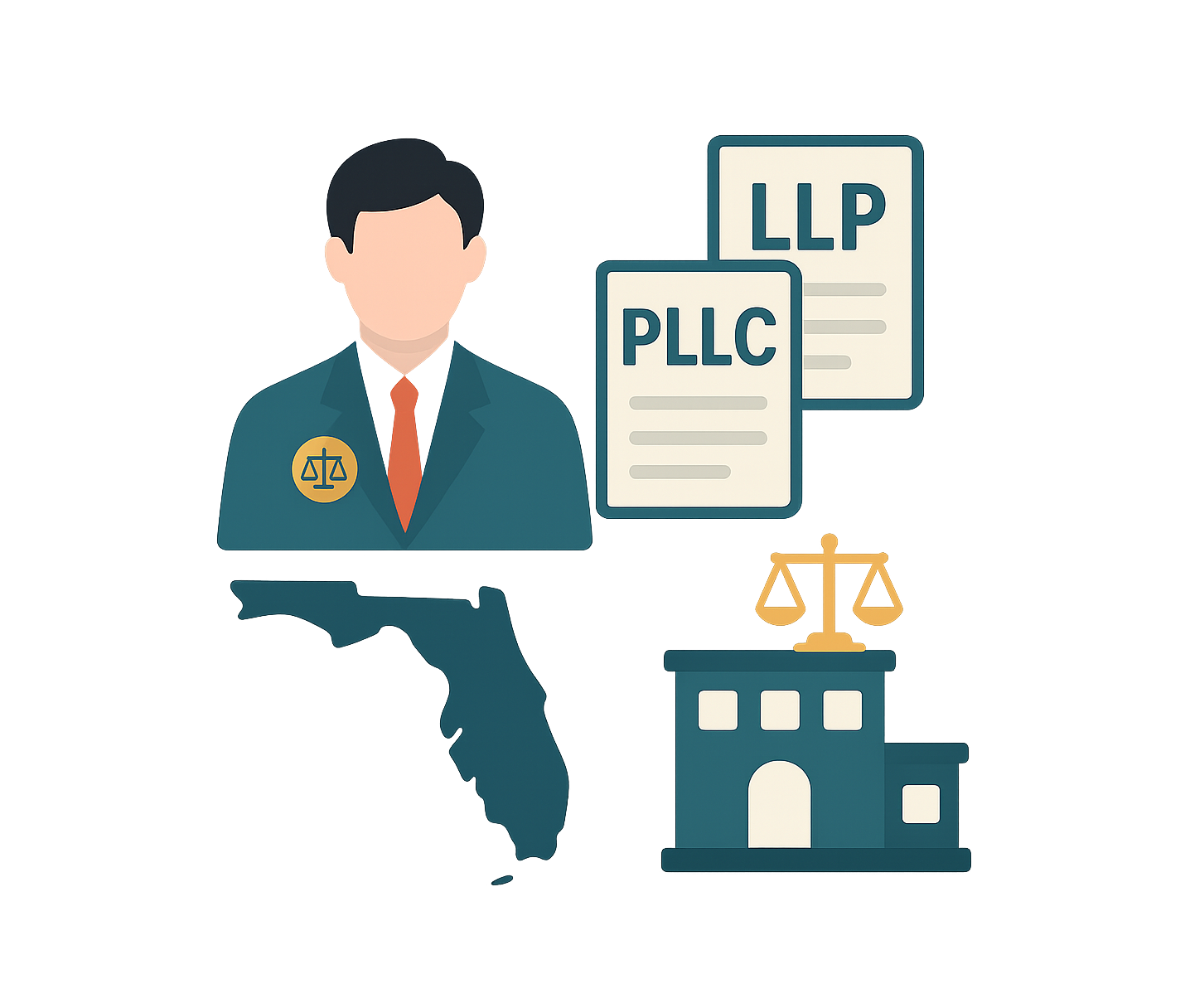
Florida law firms have several entity choices, from simple partnerships to structured corporations, each with distinct tax and liability implications. The Florida Bar permits attorneys to practice under five forms: sole proprietorship, general partnership, limited liability partnership (LLP), professional service corporation (P.A.), or professional limited liability company (PLLC). (All professional entities must use licensed owners and comply with naming rules, e.g. a PA must include “P.A.” and a PLLC “PLLC.”) Here’s how these stack up:
- General Partnership (GP) – Easiest to form, with no corporate filing. Partners share management and profits, but have unlimited personal liability for firm debts. All profits flow through to partners’ personal returns and are subject to self-employment tax (15.3% FICA) on each partner’s distributive share.
- Limited Liability Partnership (LLP) – Legally a partnership under Florida’s Revised Uniform Partnership Act (Ch. 620, F.S.), but partners register with the state and add “LLP” to the name. An LLP gives partners protection from each other’s malpractice claims while preserving pass-through taxation. (Without LLP registration, a firm remains a GP, a common mistake, and partners may mistakenly assume liability protection they don’t actually have.) Like a GP, an LLP’s income is reported on partners’ personal returns and incurs self-employment tax.
- Professional Association (P.A.) – Technically a professional corporation (one that must use licensed shareholders). A PA provides corporate-style limited liability for its lawyer-shareholders. By default a PA is taxed as a C-Corp: the firm pays Florida’s corporate income tax on its profits (5.5% as of 2025), and then shareholders pay tax on any dividends. However, a PA can elect S-corporation status (see below), converting it into a pass-through entity.
- Professional LLC (PLLC) – Essentially an LLC limited to professional members. A PLLC offers liability protection like a P.A., but by default it’s taxed as a partnership (pass-through to members) unless it elects C- or S-corp tax status. This flexibility makes PLLCs popular for small firm owners. With many members active, PLLC income flows through and is subject to self-employment tax, similar to an LLP.
Florida’s rules also allow single-member practices (sole proprietor or one-owner P.A./PLLC). In any case, entity choice affects who gets taxed and how.
Tax Treatment by Entity Type
Pass-Through vs. Entity Tax: In Florida’s tax-friendly environment, pass-through entities are especially attractive. Florida has no personal income tax, so profits that “pass through” to individual owners avoid state-level tax entirely. By contrast, C-corporations (including a P.A. taxed as C-corp) pay Florida’s 5.5% corporate tax on earnings. S-corporation and LLC/partnership income skip that level: the business records no Florida tax (there’s no K-1 withholding or state tax for owners). Key points:
- General Partnership/LLP/PLLC (Partnership Taxation): All profits and losses flow through to the owners’ personal returns. Partners/members pay federal income tax and self-employment tax (Social Security + Medicare) on their share of net earnings. The law firm itself does not pay federal income tax. Florida imposes no tax on those K-1 profits (no personal income tax). (Note: unlike S-corps, partnerships cannot issue W-2 salaries to owners – partners must take guaranteed payments or distributions reported on K-1s.)
- P.A. (Professional Corporation): By default a P.A. is a C corporation. It pays federal corporate tax on income, and pays Florida’s corporate tax (5.5%) on its net. Distributions (dividends) to partners/shareholders are then taxed again on personal returns. However, if the P.A. elects S-corp status, it becomes a pass-through entity: income flows through to shareholders and avoids that corporate tax. (S-corp shareholders still pay federal tax on K-1 income and must receive reasonable salaries, see below.)
- PLLC: By default a multi-member PLLC is treated like a partnership (pass-through with SE tax). Single-member PLLCs are disregarded (owner reports income). However, a PLLC can elect corporate tax: C-corp (then pay Florida 5.5% tax) or S-corp. An S-corp election on a PLLC means owners are shareholders of an S-corporation (pass-through taxation with wage/distribution split).
Self-Employment Taxes: Partnerships and LLC members (if no S election) are typically subject to the full 15.3% self-employment tax on their distributive share. By contrast, an S-corporation allows active owners to minimize SE taxes by taking part of income as wages (subject to payroll taxes) and the rest as distributions (no SE tax). For example, a partner earning $300,000 in a partnership would owe about $45,900 in SE tax (15.3%). If the firm converts to an S-corp and pays that partner a $150,000 salary and $150,000 distribution, the distribution portion avoids SE tax, saving roughly $20,000 in taxes.
Partner Compensation & Profit Distribution
How partners take money out differs by entity:
- Partnerships/LLPs: Partners draw against profits, reported on a Schedule K-1. All such income is taxed on their personal returns, and they owe self-employment tax on it. (Partners are not “employees,” so they don’t get W-2s for their profit shares.) Retirement and benefit plan contributions, health-insurance deductions, etc., follow partnership rules. Because every dollar is taxed as income or guaranteed payment, there’s no tax-rate arbitrage – the more you earn, the more SE tax you pay.
- S Corporations (including P.A. or PLLC electing S status): Here partners/shareholders have a dual role. They must be paid a reasonable salary (W-2 wages) for their work. This salary is subject to payroll taxes (7.65% employer + 7.65% employee up to Social Security wage base, etc.). After wages are paid, any remaining profits can be taken as distributions (dividends). These distributions (being corporate profits passed through) are not subject to self-employment (FICA) tax. In practice, this allows substantial tax savings: only the salary portion incurs payroll taxes, while distributions avoid the 15.3% SE tax. (However, the IRS will challenge unreasonably low salaries. Partners should generally take at least ~40–60% of total compensation as salary. Underpaying salary invites IRS audits and reclassification of distributions as wages.)
Tax-Efficient Pay: To illustrate, a LeanLaw guide explains that structuring compensation correctly “optimizes tax savings” and avoids costly IRS audits. Law firm owners often research industry salary surveys to set “reasonable compensation”. A typical rule of thumb is the 60/40 ratio: pay at least 40–60% of your guaranteed income as salary. For example, if a partner’s share is $200K, paying $100K as salary and $100K as distribution can save about $15K in self-employment taxes compared to taking it all as guaranteed payments. (Of course, changing entity can also affect benefits – S-corp shareholders who take W-2 wages may participate in retirement plans or deduct health premiums as employees, unlike partners under a GP.)
Florida-Specific Tax & Regulatory Factors
Florida’s tax and legal environment adds key considerations:
- No State Income Tax: Florida constitutionally prohibits individual income tax. Consequently, any pass-through income (LLP/K-1 or S-corp dividends) is free of Florida personal tax. S-corp shareholders face no state tax on their K-1 income.
- Corporate Income Tax: C-corporations (including a P.A. taxed as C-corp) pay Florida’s corporate tax. Currently that rate is 5.5% on net income. S-corps and partnerships (pass-through) do not pay this tax. (Because of this, some firms prefer S corp status for any corporation-type entity to avoid Florida’s 5.5% tax.)
- Professional Licensing Rules: Florida law (Ch. 621, F.S.) limits professional entities to licensed owners. All shareholders/members of a PA/PLLC must be licensed in the firm’s practice area. The entity must be organized for that single profession (e.g. “providing legal services”). These formalities won’t directly change taxes, but non-lawyer owners or unintended activities can violate licensing rules. (cindysfloridalllc.co)
- Liability Protections: Florida LLP law provides that properly registered LLPs shield partners from malpractice claims of other partners. A P.A. or PLLC also limits personal liability (except for one’s own negligence). By contrast, a GP or non-registered partnership offers no liability protection at all. Many small firms overlook this until after a claim: mistake, operating as an unregistered partnership thinking you’re covered.
- Compliance: Entities must maintain annual filings on Florida’s Sunbiz site. LLPs file a Statement of Qualification, P.A.s file articles of incorporation, etc.. Failure to file, or neglecting to run mandatory paperwork for an S-election, can trigger penalties or loss of tax status.
Common Mistakes to Avoid
When structuring or operating your firm, watch out for these pitfalls:
- Skipping the LLP Registration: Simply calling yourselves an “LLP” isn’t enough. You must file the proper forms. Otherwise, you remain an ordinary partnership with unlimited liability. As one Florida adviser warns, “many partnerships mistakenly assume they have liability protection without formally registering as an LLP”.
- Choosing the Wrong Default Entity: Picking a PA or PLLC when you intended a partnership (or vice versa) can complicate taxes. For instance, if you want pass-through tax but inadvertently form a C-corp, you’ll incur double tax until an S-election is made. Conversely, some firms hold an LLC (PLLC) and never revisit tax election, paying excess SE tax when an S-corp election would save.
- Underpaying Salaries in an S Corp: S-corp firms must pay reasonable W-2 wages to shareholder-employees. Firms that skim by on salaries and take large distributions risk IRS scrutiny. Underpaying salaries can trigger audits and retroactive payroll taxes. One accounting guide notes that the IRS “closely monitors S corporations” and often reclassifies low distributions as wages.
- Misclassifying Partner Compensation: In a partnership, never issue W-2 wages to a partner for partnership profits – that is incorrect. All partner compensation should be via K-1 distributions or guaranteed payments. Paying partners through payroll can create withholding errors and IRS audits.
- Ignoring Growth Changes: Many firms start as one type (e.g. single-member PLLC or small partnership) and then forget to reassess as they grow. This can mean missing out on $-saving elections or mismatch of structure to current needs (see below).
Revisiting Your Structure with Growth
As your law firm’s revenue or headcount increases, periodically reconsider your entity choice:
- Profit Thresholds: A common rule is when profits exceed roughly $100,000