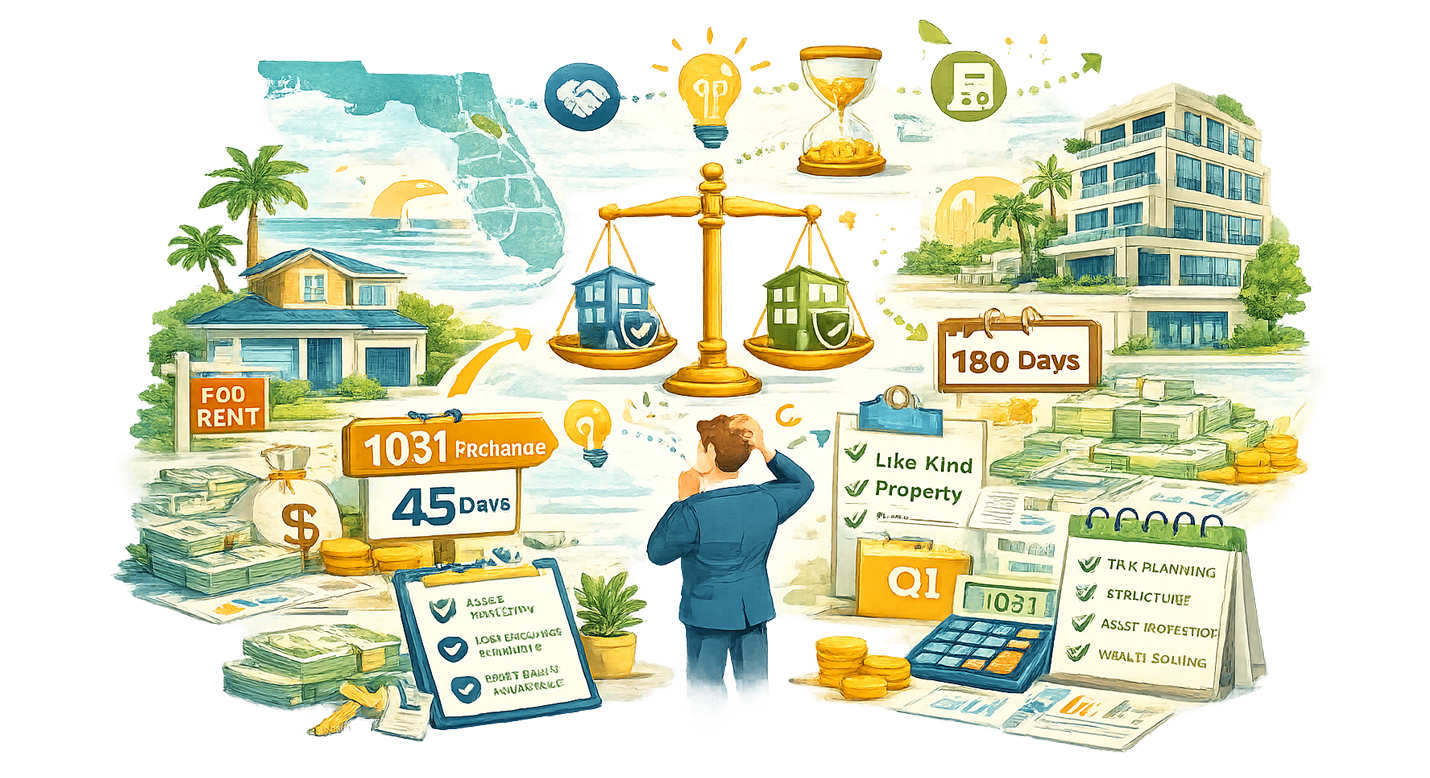
| A 1031 exchange lets Florida real estate investors defer federal capital gains taxes indefinitely by selling one investment property and reinvesting the proceeds into another like-kind property within strict IRS timelines. Because Florida has no state income tax, investors here only defer federal tax. Combined with the OBBBA’s restored 100% bonus depreciation and cost segregation, this creates the most powerful tax-deferral stack available to real estate investors in 2026. |
Whether you hold rental properties in Jacksonville, flip houses in Tampa, manage a short-term rental portfolio in Orlando, or own commercial real estate in Miami, the 1031 exchange is the single most important tax tool in your arsenal. But the rules are unforgiving: miss the 45-day identification window by one day and the entire deferral fails. This guide breaks down the rules, timelines, Florida-specific costs, and advanced strategies through the lens of an investor operating in the Florida market. Implementation for real estate investors is a whole different beast; that’s where we come in.
What Is a 1031 Exchange and Why Is Florida the Best State to Do One?
Definition: A 1031 exchange (named after IRC Section 1031) allows an investor to sell investment or business-use real property and reinvest the proceeds into “like-kind” replacement property while deferring ALL federal capital gains taxes, including long-term capital gains (0%, 15%, or 20%), depreciation recapture (25% under Section 1250), and the 3.8% Net Investment Income Tax (NIIT).
“Deferral, not elimination”: The tax is deferred, not forgiven. When you eventually sell without exchanging, the accumulated gains become taxable. However, many investors exchange repeatedly throughout their careers, and at death, the heirs receive a stepped-up basis, effectively eliminating the deferred gain permanently.
Florida’s unique advantage: Florida has no state income tax and no state capital gains tax. This means a 1031 exchange in Florida defers only federal tax. Compare this to California (up to 13.3% state capital gains), New York (up to 10.9%), or New Jersey (up to 10.75%) where investors must also navigate state-level exchange rules or clawback provisions. Florida investors have the cleanest, simplest 1031 exchange environment in the country.
Florida is not just great for doing 1031 exchanges; it is also a magnet for OUT-OF-STATE investors exchanging into Florida to escape high-tax-state clawback provisions.
What Are the Deadlines and Timeline for a 1031 Exchange?
Day 0: The sale of the relinquished property closes. The exchange clock starts. Proceeds go directly to the Qualified Intermediary (QI). The investor NEVER touches the money.
Day 1 – Day 45 (Identification Period): The investor must identify potential replacement properties in writing to the QI. Three identification rules apply (see below). This deadline is absolute – no extensions, not even for hurricanes, unless the IRS issues a specific disaster relief notice for your Florida county.
Day 1 – Day 180 (Exchange Period): The investor must close on one or more of the identified replacement properties. The 180-day deadline runs concurrently with the 45-day window (not in addition to it).
Identification Rules Table:
| Rule | What It Allows | When to Use |
| Three-Property Rule | Identify up to 3 replacement properties of any value | Most common. Simple and safe for most investors. |
| 200% Rule | Identify unlimited properties, but total FMV cannot exceed 200% of relinquished property’s sale price | When exploring multiple smaller properties (e.g., selling one $1M property in Miami and identifying several $300K-$400K rentals in Jacksonville). |
| 95% Rule | Identify unlimited properties of any value, but you MUST acquire 95% of total identified value | Rarely used & extremely risky. Failure to close on nearly everything identified kills the exchange. |
What Qualifies as “Like-Kind” Property in Florida?
The rule is broad: Any real property held for investment or business use qualifies as like-kind to any other real property held for investment or business use. The properties do NOT need to be the same type. Nvvndf,mnvmnm nvn j ndnvvnv ksdmklmlkmmczm,
Florida examples: A single-family rental in Stuart → a multifamily apartment in Orlando. Vacant land in the Panhandle → a commercial warehouse in Jacksonville. A duplex in Fort Lauderdale → an office building in Tampa. A long-term rental in Sarasota → a short-term vacation rental in Kissimmee.
What does NOT qualify: Primary residences. Personal-use vacation homes (unless properly converted to rental use). Fix-and-flip inventory held as dealer property (held primarily for sale). Personal property and intangible property (post-TCJA, effective January 1, 2018).
Critical distinction: The property must be held for investment or business use, not for personal use or for sale as inventory. This catches house flippers who hold properties as dealer inventory. Those sales are ordinary income, not eligible for 1031.
If you don’t know what entity to structure your rentals as see our “LLC vs. S-Corp” article.
How Does Boot Work and How Do You Avoid It?
Definition: “Boot” is anything received in the exchange that is NOT like-kind replacement property. Boot is taxable. The two most common types are cash boot (receiving leftover cash from the QI) and mortgage boot (taking on less debt than you had on the relinquished property).
The full-reinvestment rule: To achieve FULL tax deferral, you must reinvest ALL equity proceeds AND replace ALL debt. If you sell a property for $800K with a $500K mortgage (netting $300K in equity), you must purchase replacement property worth at least $800K, reinvest the full $300K equity, and take on at least $500K in new debt (or substitute additional cash).
Florida-specific boot trap (documentary stamp tax): Florida documentary stamp tax ($0.70 per $100 in most counties, $0.60 in Miami-Dade) is paid at closing and reduces net proceeds. If you do not account for this, you may inadvertently under-reinvest and receive taxable boot. The nonrecurring intangible tax (2 mills on any new mortgage) also applies.
What Does a 1031 Exchange Cost in Florida?
Cost Comparison Table:
| Cost | Amount | Applies To | Notes |
| QI fee | $800–$1,500 (standard) / $3,000–$8,000 (reverse) | Both relinquished and replacement transactions | FL does NOT regulate or license QIs. No state bonding requirement. |
| Documentary stamp tax | $0.70 per $100 (most counties) / $0.60 per $100 (Miami-Dade) | Both property deed transfers | NOT deferred by the 1031 exchange. Owed at closing regardless. |
| Miami-Dade surtax | Additional $0.45 per $100 | Real property transfers in Miami-Dade only | Unique to Miami-Dade. Total rate: $1.05 per $100 ($0.60 + $0.45). |
| Intangible tax | 2 mills ($0.002 × mortgage) | Any new mortgage recorded in FL | Triggered when financing the replacement property. Not deferred. |
| Title insurance | Varies (FL-regulated rates) | Replacement property closing | Florida title insurance rates are set by the state. |
| CPA advisory fees | Varies | Pre-exchange planning, Form 8824 reporting | Strongly recommended. The CPA should be engaged BEFORE the sale. |
| Example:
Selling a $750K rental in Broward County: Doc stamps on sale = $5,250. Buying $900K replacement in Hillsborough County: Doc stamps on purchase = $6,300. New mortgage of $650K: Intangible tax = $1,300. QI fee = ~$1,200. Total Florida-specific exchange costs: ~$14,050. And this is BEFORE standard closing costs. |
How Do You Choose a Qualified Intermediary in Florida?
No state regulation: Florida does NOT license, bond, or regulate Qualified Intermediaries. There is no state oversight body. If the QI mishandles or loses your exchange funds, your only recourse is civil litigation.
Disqualifying relationships: Your QI cannot be someone who has acted as your attorney, CPA, real estate agent, investment banker, or broker within the past 2 years (or their employees).
What to look for: Fidelity bond, errors and omissions (E&O) insurance, segregated FDIC-insured escrow accounts (NOT commingled), audited financials, and experience with Florida real estate transactions specifically.
Florida metro QI markets: Qualified intermediaries operate across Florida’s major metros: Orlando, Tampa, Miami, Jacksonville, Fort Lauderdale, Sarasota, Naples. A QI experienced with Florida documentary stamp tax nuances and Miami-Dade surtax calculations is valuable.
What Are the Different Types of 1031 Exchanges Available to Florida Investors?
| Exchange Type | How It Works | Best For | Complexity / Cost |
| Delayed (Forward) | Sell relinquished property first, buy replacement within 180 days | Most investors. Standard rental portfolio repositioning. | Low. QI fee $800-$1,500. |
| Simultaneous | Close on both properties the same day | Rare. Requires perfect coordination. | Low cost, high logistical risk. |
| Reverse | Buy replacement first, sell relinquished within 180 days | Hot FL markets (Miami, Tampa, Orlando). Competitive bid situations. | High. QI/EAT fees $3,000-$8,000. FL doc stamps may apply twice. |
| Improvement / Build-to-Suit | Use exchange proceeds to construct or improve replacement property during 180-day period | New construction. Post-hurricane rebuild (Cape Coral, Fort Myers, SW FL). | High. Requires EAT. Improvements must complete within 180 days. |
Florida-Specific Reverse Exchange Trap: Documentary Stamp Tax on EAT Transfer
In a reverse exchange, the EAT takes title to the “parked” property. When the parked property transfers FROM the EAT back to the investor at the end of the exchange, Florida may impose documentary stamp tax on that transfer.
Florida requires specific agency language in the Qualified Exchange Accommodation Agreement and in the Purchase and Sale Agreements for the EAT-to-taxpayer transfer to be exempt from documentary stamp tax.
If this language is missing, the investor pays doc stamps TWICE, once when the EAT acquires the property and again when the EAT transfers it to the investor. On a $1M property, that is $14,000 in unnecessary tax.
How Do 1031 Exchanges and Cost Segregation Work Together Under the OBBBA?
The OBBBA restored 100% bonus depreciation permanently for qualified property acquired after January 19, 2025. This reversed the phase-down and made cost segregation studies dramatically more valuable.
The 1031 + cost segregation combination: Sell a fully depreciated rental property via 1031 exchange → acquire replacement property → perform a cost segregation study on the replacement property → claim 100% bonus depreciation on identified short-life components (5, 7, and 15-year property) in year one.
Dollar example: Investor sells a $1M property in Sarasota with zero remaining depreciable basis → 1031 exchanges into a $1.2M property in Tampa → cost segregation identifies $360K in short-life assets → 100% bonus depreciation produces a $360K deduction in year one. The original gain is deferred, and the investor generates a massive current-year deduction.
The triple stack: 1031 exchange (defers gain) + cost segregation (accelerates deductions) + Florida’s no-state-income-tax environment (no state tax on any of it) = the most efficient tax strategy available to Florida real estate investors.
Can You 1031 Exchange a Vacation Rental or Airbnb Property in Florida?
Yes, IF it qualifies as investment property. Short-term rentals listed on Airbnb, VRBO, etc. can qualify for 1031 exchange treatment if they are held for investment, not personal use.
Revenue Procedure 2008-16 Safe Harbor: The IRS safe harbor requires the property to be rented at fair market rates for at least 14 days per year AND limits personal use to no more than 14 days OR 10% of total rental days (whichever is greater) in each 12-month period during the 24 months before the exchange.
The Florida trap: Investors who own vacation rentals in Destin, the Keys, Anna Maria Island, or along 30A often blur the line between personal use and investment use. If you spend 3 weeks at your own rental each year, you may disqualify it from 1031 treatment.
Documentation is everything: Rental agreements, Airbnb/VRBO booking records, property management statements, advertising materials, and contemporaneous logs of personal-use days.
Converting a personal vacation home: If you currently use a property personally but want to 1031 exchange it, you must convert it to rental use and meet the safe harbor for at least 24 months before selling.
What Happens If You Exchange Property INTO Florida from Another State?
Florida as a 1031 destination: Florida’s no-income-tax status makes it the top destination for investors exchanging out of high-tax states.
BUT the origin state may still tax you: California uses a “clawback” provision under Revenue and Taxation Code Sections 18032/24953. California takes the position that gain accrued on California soil belongs to California, forever. When the Florida replacement property is eventually sold (even decades later), California taxes the original deferred gain. The investor must file California Form FTB 3840 EVERY year. California also withholds 3.33% of the sale price at closing. Other clawback states include Massachusetts, Montana, and Oregon.
Florida-to-Florida exchanges: No interstate complications. No state tax in either direction. Cleanest possible exchange.
Planning opportunity: Investors exchanging into Florida from high-tax states need a CPA who understands BOTH the origin state’s rules and Florida’s cost structure.
Can Florida Opportunity Zones Work with a 1031 Exchange?
Both 1031 exchanges and Opportunity Zone investments defer capital gains, but the mechanics and benefits differ. Here’s how we break it down:
| Comparison | 1031 Exchange | Opportunity Zone |
| Gain deferral | Yes, indefinitely through serial exchanges | Yes, deferred until 2026 tax year or sale of OZ investment |
| Tax-free appreciation | No (deferred, not eliminated, unless stepped-up basis at death) | Yes, if held 10+ years, gain on the OZ investment is tax-free |
| Property type | Like-kind real property only | Any qualified property in a designated OZ census tract |
| Geographic restriction | None (any US real property) | Must be in a designated Opportunity Zone |
| Timeline | 45-day ID / 180-day close | 180 days to invest gain into QOF |
| Florida zones | N/A | 427 zones statewide (OZ 1.0); ~340 new zones coming 2027 (OZ 2.0) |
What Florida-Specific Due Diligence Must You Do Before Identifying Replacement Property?
Insurance Costs Can Kill Your Exchange ROI
Florida property insurance costs can make or break the investment math on a replacement property.
FEMA Risk Rating 2.0: The old flood-zone shorthand no longer tells the full story. Two homes on the same street can have premiums differing by thousands based on elevation and foundation type. ALWAYS get an insurance quote BEFORE identifying a replacement property during your 45-day window.
Wind mitigation inspection: A professional wind mitigation report can save 30-50% on the wind portion of the premium. Reference the My Safe Florida Home program (up to $10,000 in state grants for mitigation improvements).
Citizens Property Insurance: Florida’s insurer of last resort is implementing an average 8.7% rate reduction statewide for 2026, with larger drops in Broward County (14.1%) and Miami-Dade (13.9%).
Property Tax Reset on Replacement Property
Investment properties in Florida do NOT receive a homestead exemption; they are assessed at full just/market value.
Non-homestead properties have a 10% annual assessment increase cap (FL Constitution, Article VII, Section 4), but when a property is SOLD, the assessed value resets to the current just/market value. This means your replacement property’s first-year tax bill may be significantly higher than the previous owner’s.
Always check the county property appraiser’s website for current just values and millage rates before identifying a replacement property. Each of Florida’s 67 counties handles assessments independently.
When Should You Talk to a Florida CPA About Your 1031 Exchange?
Before you sell, not after. The most common mistake is engaging a CPA after the relinquished property is already under contract. By then, critical structuring decisions have already been made (or missed).
What the CPA does: Pre-exchange tax modeling (estimating deferred gain, depreciation recapture, boot exposure), coordinating with the QI and closing attorney, reviewing the identification list during the 45-day window, structuring cost segregation on the replacement property, filing Form 8824, and managing the ongoing depreciation schedule.
Florida-specific value: A Florida CPA understands documentary stamp tax calculations, Miami-Dade surtax, intangible tax, reverse exchange EAT documentation requirements, and county-by-county property tax assessment dynamics, none of which a national CPA firm will know.
Every exchange is different. The right strategy depends on your gain amount, portfolio goals, timeline, and whether your income is active or passive. Schedule a consultation with a Florida CPA before you list your property.
FAQ Section (7 Questions)
Does Florida have a state capital gains tax on 1031 exchanges?
No. Florida has no state income tax and no state capital gains tax. A 1031 exchange in Florida defers only federal taxes, long-term capital gains (up to 20%), depreciation recapture (25%), and the 3.8% Net Investment Income Tax. This makes Florida one of the most tax-friendly states for real estate exchanges.
What is the 45-day rule in a 1031 exchange?
After selling your relinquished property, you have exactly 45 calendar days to identify potential replacement properties in writing to your Qualified Intermediary. This deadline is absolute with no extensions. Most investors use the Three-Property Rule, which allows identifying up to three properties of any value.
Can I 1031 exchange into a short-term rental or Airbnb property in Florida?
Yes, if the property is held as an investment and meets the IRS safe harbor under Revenue Procedure 2008-16. The property must be rented at fair market rates for at least 14 days per year, and personal use cannot exceed 14 days or 10% of rental days. Documentation is essential.
What is boot in a 1031 exchange?
Boot is any non-like-kind value received during the exchange, typically cash left over or debt reduction. Boot is taxable. In Florida, documentary stamp tax and intangible tax reduce net proceeds at closing, which can accidentally create boot if not accounted for in exchange calculations.
Does Florida require a licensed Qualified Intermediary?
No. Florida does not license, bond, or regulate Qualified Intermediaries. There is no state oversight. Investors must independently evaluate their QI’s qualifications, insurance coverage, and financial stability. Look for fidelity bonds, E&O insurance, and segregated FDIC-insured escrow accounts.
Can I do a 1031 exchange from California into Florida?
Yes, but California will “claw back” state taxes on the original deferred gain when the Florida replacement property is eventually sold. You must file California Form FTB 3840 annually while holding the Florida property. Florida imposes no state tax on its end, making it a popular exchange destination.
How does a 1031 exchange work with cost segregation and bonus depreciation?
Sell a property via 1031 exchange, deferring all gains. Perform a cost segregation study on the replacement property to identify short-life assets (5, 7, 15-year property). Under the OBBBA, claim 100% first-year bonus depreciation on those assets. This combination defers gain AND creates immediate deductions.
Why 1031’s are Necessary For Florida Real Estate Investors
Florida has no state income tax, a clean exchange environment, powerful stacking with cost segregation, and OBBBA bonus depreciation. However, it also has strict deadlines, an unregulated QI market, insurance costs, and doc stamp traps. You should always engage a Florida CPA before you list your property. Cloud Accounting Group specializes in helping Florida real estate investors plan, execute, and report 1031 exchanges, from pre-sale tax modeling through post-exchange depreciation strategy.
Research Resources
IRS Primary Sources (1031 Exchange Rules)
IRS — Like-Kind Exchanges: Real Estate Tax Tips — The official IRS page on Section 1031. Cite as primary authority.
IRS Fact Sheet FS-08-18 — Like-Kind Exchanges Under IRC Section 1031 — PDF with detailed IRS guidance.
IRC Section 1031 — Full Text (Cornell LII) — Statutory text of Section 1031.
1031 Exchange Rules and Timelines (General)
DoorLoop — IRS 1031 Exchange Rules for 2026 — Clear breakdown of timelines and identification rules.
AskDoss — 1031 Exchange Rules 2026 — Three-Property Rule, 200% Rule, 95% Rule explained.
Anchor1031 — The Complete Guide to 1031 Exchanges (2026) — Comprehensive QI-published resource.
Kahn Litwin — 1031 Exchanges in 2026: What’s Changed — 2026 update. OBBBA impact and current status.
Florida-Specific 1031 Exchange Rules
Realized1031 — Key Rules for a 1031 Exchange in Florida — FL-specific rules. No state income tax, doc stamp tax, QI considerations.
Universal Pacific — 1031 Exchange Rules Florida — FL investor focus. QI selection and cost breakdown.
Steadily — FL 1031 Exchange Rules for RE Investors — Common pitfalls and mistakes.
Landsberg Bennett (FL CPA firm) — 1031 Exchange Explained — Florida-based CPA firm. Strong local authority link.
Florida Documentary Stamp Tax and Transfer Costs
FL Dept. of Revenue — Documentary Stamp Tax — Official FL state source. Highest-authority local link.
FL Dept. of Revenue — Nonrecurring Intangible Tax — Official FL source. 2 mills on new mortgages.
DeedClaim — FL Documentary Stamp Taxes — Rate tables including Miami-Dade surtax.
Reverse Exchanges and Improvement Exchanges
Legal1031 — FL Reverse 1031 Exchanges: Tax Rules & EAT Compliance — FL-specific EAT documentation. Critical for avoiding double doc stamps.
Anchor1031 — Reverse 1031 Exchange Guide — Comprehensive reverse exchange mechanics.
IPX1031 — Improvement Exchanges / Build-to-Suit 1031 — Definitive guide to construction/improvement exchanges.
Cost Segregation + 1031 Exchange + OBBBA
1031Corp — Cost Segregation and 1031 Exchanges in the OBBBA Era — Best source on the triple stack strategy.
Schaaf CPA — RE Investor Tax Guide 2026: What the OBBBA Changed — Comprehensive OBBBA impact guide.
CBIZ — Combining 1031 Exchanges and Cost Segregation — CPA firm analysis.
Kiplinger — 2026 Seismic Shift in Tax Rules for RE Investors — Media coverage of the OBBBA + 1031 opportunity.
Vacation Rentals and Personal-Use Property
AvantStay — 1031 Exchange Rules for Short-Term Rentals (2026) — Revenue Procedure 2008-16 safe harbor.
Deferred.com — Can You 1031 Exchange a Vacation Home? — Personal use vs. investment use distinction.
CPEC1031 — Can Airbnb/VRBO Properties Qualify for 1031? — Practical guidance for STR investors.
Interstate Exchanges and California Clawback
1031 Specialists — California’s “Clawback” (Form 3840) — Definitive clawback guide.
IPX1031 — California Clawback for 1031 Exchange Properties — QI perspective on clawback mechanics.
Accruit — 1031 Exchanges & State Tax Law Considerations — Multi-state overview. Which states claw back.
Florida Opportunity Zones
OpportunityZones.com — Qualified OZs in Florida — Interactive Florida OZ map. 427 zones.
Discover South Florida — Countdown to OZ 2.0 — OZ 2.0 transition timeline.
Orange County FL — Opportunity Zones — County-level OZ resource (Orlando).
Hillsborough County — Opportunity Zones — County-level OZ resource (Tampa).
Florida Insurance and Due Diligence
FEMA — Flood Insurance (NFIP) — Federal flood insurance overview.
Ocean to River Properties (FL) — Flood Zones vs. FEMA Maps 2026 — FL broker on Risk Rating 2.0.
My Safe Florida Home Program — State grant program for wind mitigation (up to $10,000).
Florida Property Tax and County Resources
FL Dept. of Revenue — Property Tax Local Officials — Links to all 67 county property appraisers.
Hillsborough County Property Appraiser (Tampa) — County PA for Tampa area.
Orange County Property Appraiser (Orlando) — County PA for Orlando area.
Florida Statutes
FL Legislature — Chapter 689: Conveyances of Land — Governs how real property is transferred in FL.
FL Legislature — Chapter 201: Excise Tax on Documents — Statutory basis for documentary stamp tax.
FL Senate — Chapter 475: Real Estate License Law — Governs brokers, agents, and appraisers.
Qualified Intermediary Resources (Florida)
Barnes Walker (Bradenton, FL) — QI in 1031 Exchange — FL law firm. Strong local authority link.
Real Estate Bees — Best 1031 Exchange Companies in Orlando FL — Local QI directory for Orlando.
Real Estate Bees — Best 1031 Exchange Companies in Miami FL — Local QI directory for Miami.
Treasure Coast MLS — 1031 Exchange: FL Rules & Resources — Treasure Coast local resource.