You closed on the deal, signed the lease, and started collecting rent right on schedule. Then tax season rolls around, and suddenly you’re wondering if you’ve been doing this all wrong.
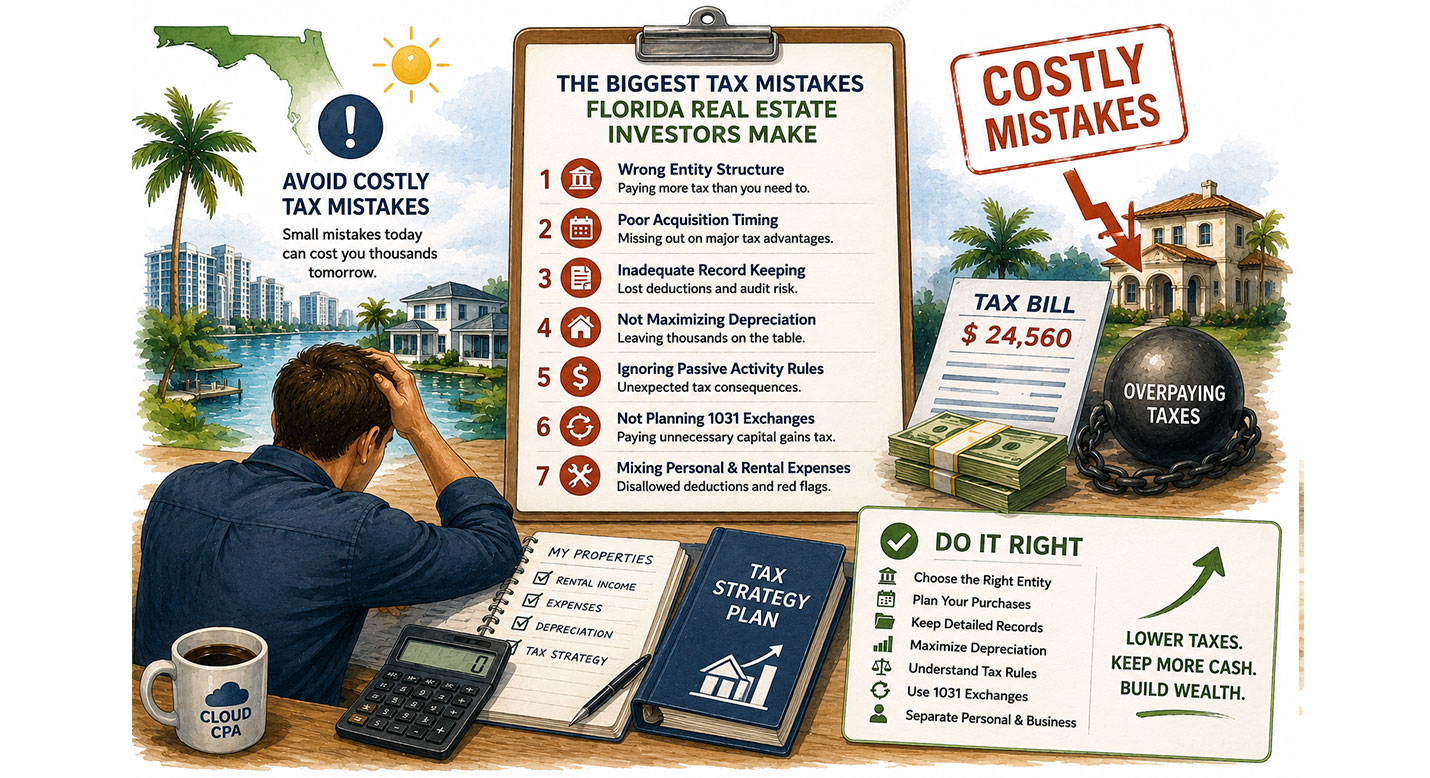
This might include overpaying because of avoidable planning mistakes, choosing the wrong entity, missing depreciation opportunities, letting bookkeeping slide, or waiting until tax season to make any of it a priority. These are some of the most common, and the costliest, mistakes we see.
But the good news is that most tax mistakes you might make as a Florida real estate investor are fixable. And once you know what to look for, avoiding these pitfalls is simpler than you might expect.
At Cloud Accounting Group, Tony Tropeano, CPA, brings 14 years of experience helping real estate investors across Florida catch these mistakes before they get expensive. Below, we’ll walk through the 12 most common ones, and exactly what to do instead.
Why Do So Many Florida Real Estate Investors Overpay in Taxes?
Most investors spend their energy finding the next property, not building a tax strategy around the ones they already own. That’s understandable. Deals are exciting, after all. Tax planning, not so much.
But the tax code rewards investors who plan ahead, not the ones who scramble in March. Entity structure, depreciation, documentation, and timing decisions all compound over years, and small oversights add up fast across a growing portfolio.
The good news is that while all of these mistakes get more expensive the longer they go unaddressed, they’re also avoidable once you know what to look for.
1. Waiting Until Tax Season to Start Planning
By the time you’re sitting across from your CPA in March, most of your best opportunities for that tax year are already gone. Entity elections, retirement contributions, and purchases timed for deductions all need to happen before December 31, not after.
Waiting until filing season means your only option is to report what already happened—you can no longer do anything about it. There’s no fixing a missed entity election in March, and there’s no retroactively timing a purchase that has already closed.
The simplest fix is to work with a CPA who checks in throughout the year, not just at filing time. For more on when this should start, see our guide on when a real estate investor should start tax planning.
2. Choosing the Wrong Entity Structure
Many investors default to owning property in their own name, or set up an LLC once and never revisit it as the portfolio grows. Both can be costly.
For example, personal ownership exposes your other assets to liability from a single bad tenant or accident.
And if you’re actively flipping properties rather than holding them for rental income, the IRS may classify you as a real estate “dealer,” which means your profits get hit with self-employment tax on top of ordinary income tax, a cost buy-and-hold investors don’t face.
The right structure depends on how you invest, not just how many properties you own. See our guide to LLC vs. S-Corp Structures for Florida Real Estate Investors before your next purchase, not after.
3. Missing Out on Cost Segregation
Standard depreciation spreads deductions evenly over 27.5 years for residential rentals. A cost segregation study can pull a meaningful share of that value forward into the first few years of ownership instead, which means money in your pocket sooner rather than decades from now.
Investors who skip this step on properties over $500,000 routinely leave five and six figures of deductions on the table. The cost of waiting isn’t just the deductions you didn’t accelerate. It’s the years of cash flow you never had the ability to reinvest.
For the full breakdown, read Cost Segregation for Florida Real Estate Investors.
4. Not Leveraging Available Depreciation Strategies
Some investors skip depreciation entirely to simplify their bookkeeping, assuming it’s optional. It isn’t, not in any way that helps you. You see, at sale, the IRS recaptures the depreciation you should have claimed, whether you claimed it or not.
That means skipping it doesn’t avoid the tax. It just guarantees you pay it without ever getting the benefit along the way.
The good news is that missed years are often recoverable. Filing IRS Form 3115 allows many investors to claim a catch-up deduction for depreciation they never took.
If it’s been a while since you looked at your depreciation approach, see Four Depreciation Strategies for Florida Rental Property Investors before you assume that the opportunity has passed.
5. Failing to Properly Qualify for Real Estate Professional Status
Real estate professional status (REPS) lets qualifying investors deduct rental losses against ordinary income, including a W-2 salary. Without it, those losses are passive and can only offset passive income.
The mistake isn’t claiming REPS, but claiming it without the documentation to back it up.
Under IRC Section 469(c)(7), you need to clear both a 750-hour threshold and a 50%-of-personal-services test every year, and the IRS has successfully challenged claims built on records reconstructed after the fact rather than logged in real time.
If you think you might qualify, start a contemporaneous time log today, not at filing time. For the full requirements, see How to Qualify for Real Estate Professional Status and Protect Your Deductions.
6. Poor Bookkeeping Throughout the Year
Mixing personal and rental accounts, letting receipts pile up, and reconciling once a year instead of monthly all create the same problem: by tax time, nobody, including you, can say with confidence what each property truly earned or cost.
This isn’t just a tax-season headache. Disorganized books make it nearly impossible to spot an underperforming property, plan for a renovation, or apply for financing with confidence.
Tracking income and expenses by property, ideally in cloud-based software like Xero, turns tax prep into a formality instead of a scramble. See Real Estate Investor Bookkeeping: How to Set Up Your Books for Maximum Tax Savings for a full walkthrough.
7. Not Keeping Proper Documentation
Good bookkeeping and good documentation aren’t quite the same thing. You can have clean books and still lose a deduction if you can’t produce the receipt, mileage log, or closing statement behind it.
This is because the IRS doesn’t take your word for an expense. It wants proof in the form of dated receipts, a documented business purpose, and records kept as you go, not reconstructed months later.
Missing documentation on even a handful of expenses can mean disallowed deductions if you’re ever audited, regardless of whether the expense was legitimate.
A simple habit fixes most of this, though. Be certain to photograph every receipt the day you get it, and note what it was for.
8. Confusing Repairs with Capital Improvements
This is one of the most common, and most expensive, classification mistakes in real estate. Repairs restore a property to its prior condition and are deducted immediately. Improvements add value or extend useful life, and must be capitalized and depreciated over time.
Get it wrong in one direction, and you’re expensing something the IRS expects you to depreciate, a compliance risk if you’re audited. Get it wrong the other way, and you’re capitalizing something you could’ve deducted this year, which ultimately means overpaying taxes you didn’t owe.
For Florida investors making hurricane-resistant upgrades especially, the line isn’t always obvious.
9. Ignoring 1031 Exchange Opportunities
A 1031 exchange lets you defer capital gains tax when you sell a property and reinvest the proceeds into another one, but the rules leave zero room for error. You have 45 days after closing to identify replacement property in writing, and 180 days to close on it.
Investors who don’t plan for a sale in advance routinely miss the identification window entirely, which means full capital gains recognition on a sale they could have deferred. By the time you’re a week from closing, it’s already too late to set up a qualified intermediary.
If a sale is even a possibility this year, it’s worth a conversation now. Our 1031 Exchange Guide for Florida Real Estate Investors breaks down the full timeline.
10. Treating Short-Term Rentals Like Traditional Rentals
Florida’s coastal markets are full of Airbnb and VRBO investors, and many of them apply long-term rental tax rules to a property that doesn’t follow the same playbook. Under IRC Section 469(c)(2), rentals averaging seven days or fewer per guest stay officially fall outside standard passive activity rules, which changes how losses are treated.
A related, often-missed detail is that if you also use the property yourself, even occasionally, those personal-use days affect how much of your expenses you can deduct. Skipping that allocation is a way to overstate deductions without realizing it.
See Short-Term Rental Tax Strategies for Florida Airbnb and VRBO Investors for the full rules, including Florida’s tourist development tax.
11. Missing Legitimate Rental Property Deductions
There’s a long list of rental property tax deductions investors routinely underuse simply because they don’t know they qualify:
- HOA dues
- Mortgage interest
- Travel to and from each property
- A portion of your home internet if you manage rentals from home
- Professional fees
- Insurance
This mistake tends to compound unnoticed until it’s too late to rectify. Plus, a missed deduction this year doesn’t just cost you this year’s tax savings—left unchecked, it repeats every single year.
That’s why a mid-year review with your CPA is the fastest way to catch what you’re missing right now.
12. Never Revisiting Your Tax Strategy as Your Portfolio Grows
The strategy that worked for your first rental rarely fits your fifth. Adding properties, mixing short-term and long-term rentals, or moving into commercial real estate all change your passive activity exposure, your entity needs, and your depreciation planning.
Investors who set up their tax strategy once and never look at it again are often the ones most surprised at tax time, not because anything went wrong, but because their portfolio outgrew the plan without them realizing it.
A strategy review with your CPA doesn’t need to happen every year, but it should happen every time something major changes.
What Should Florida Real Estate Investors Do Instead?
Avoiding the mistakes above doesn’t require a complicated overhaul. Instead, the key is to prioritize a few specific habits that will serve you well long-term:
- Develop a tax strategy before you buy, not after you close
- Keep your bookkeeping current, not caught up once a year
- Choose the ownership structure that fits how you prefer to invest
- Revisit your tax planning throughout the year, not just in the spring
- Update your strategy as your portfolio grows, rather than letting it run on autopilot
- Loop in your CPA before major transactions, like a sale, a refinance, or a new entity
At Cloud Accounting Group, Tony Tropeano, CPA, and our team work with Florida real estate investors like yourself to build exactly this kind of proactive, forward-looking strategy. Schedule your free 30-minute discovery call with Nik Watson, our CEO, to start building your custom strategy today.
Or, for a comprehensive look at the strategies behind getting all of this right, our Ultimate Florida Real Estate Investor Tax Planning Guide walks through every major topic in depth, from entity structure and 1031 exchanges to cost segregation, depreciation, and real estate professional status.
Frequently Asked Questions
Should I own my rental property in an LLC?
Yes, for most Florida investors. An LLC separates your personal assets from your rental property, which limits what’s exposed if a tenant or visitor ever sues. Florida’s charging order protection makes LLCs especially favorable for investors here, since it limits a creditor’s ability to seize the LLC itself.
You can confirm formation requirements through the Florida Division of Corporations. Whether each property needs its own LLC depends on your portfolio size and risk tolerance.
What is the biggest tax mistake real estate investors make?
Waiting until tax season to think about taxes at all. Nearly every other mistake on this list, from the wrong entity, to missed depreciation, to a blown 1031 deadline, traces back to a decision made without a tax strategy already in place.
The IRS calculates many deductions and elections based on choices made before a transaction closes, not after. By the time you’re filing, the opportunity to fix most of these has already passed for that year.
Should I work with a CPA who specializes in real estate investors?
For most investors with more than one property, yes. A specialist CPA typically catches:
- Entity and REPS opportunities a generalist might miss
- 1031 exchange and cost segregation timing
- Deductions specific to rental and short-term rental income
The savings usually outweigh the cost many times over. If you’d like to learn more about the benefits of working with a CPA who specializes in real estate investors, book your free 30-minute discovery call with us today.