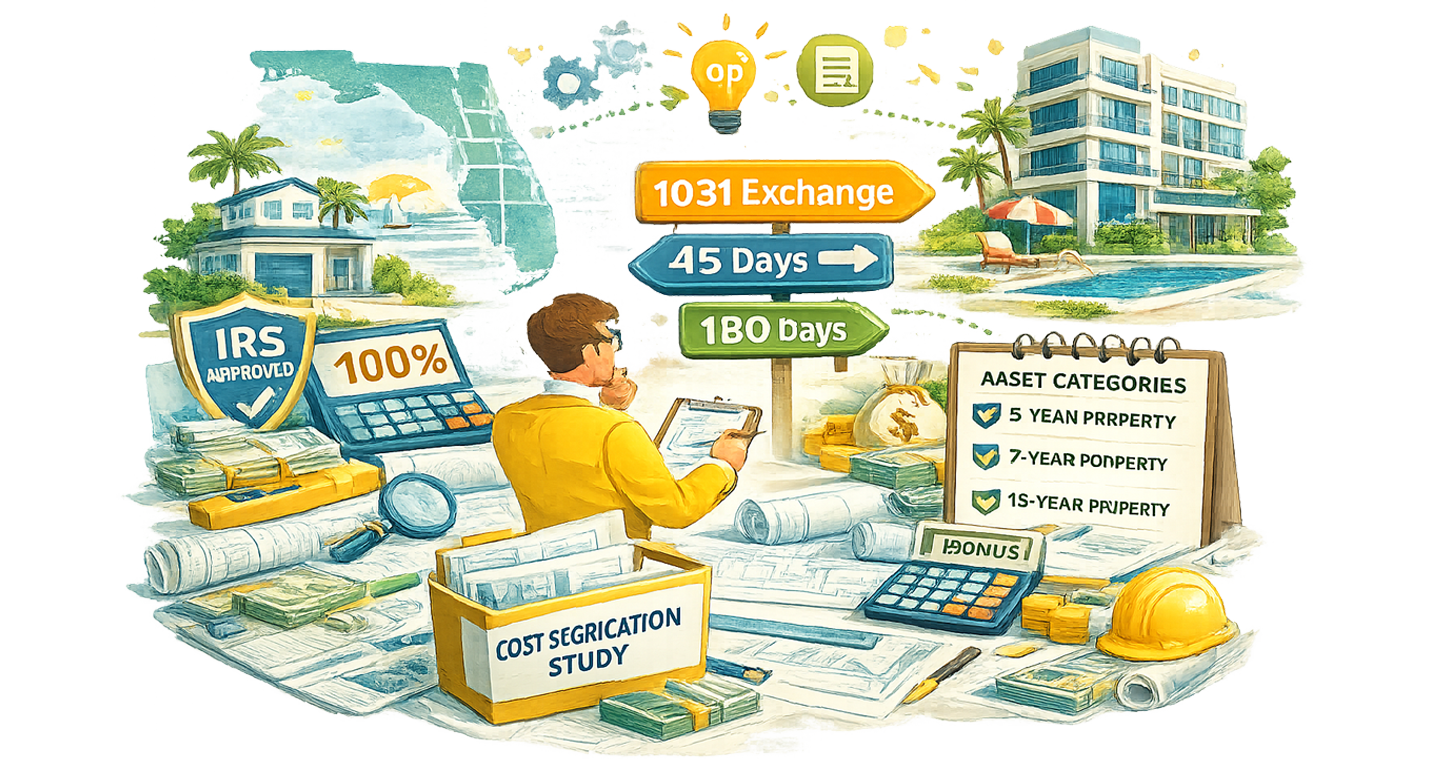
A cost segregation study is an IRS-approved tax strategy that reclassifies components of a commercial or investment property from the standard 27.5- or 39-year depreciation schedule into shorter 5-, 7-, and 15-year categories. This allows Florida real estate investors to accelerate hundreds of thousands of dollars in depreciation deductions into the early years of ownership. With the One Big Beautiful Bill Act (OBBBA) permanently restoring 100% first-year bonus depreciation for qualifying property acquired after January 19, 2025, cost segregation has become the single most powerful tax tool available to Florida real estate investors in 2026.
Whether you own rental properties in Jacksonville, self-storage facilities in Tampa, multifamily buildings in Orlando, or short-term vacation rentals along Florida’s Gulf Coast, a properly executed cost segregation study can generate five- to six-figure tax deductions in the first year of ownership. And because Florida has no state income tax, every dollar of accelerated depreciation flows directly to the federal return with no state-level dilution.
This guide breaks down how cost segregation works, what property components qualify, how it pairs with 1031 exchanges and bonus depreciation under the OBBBA, and when it makes sense for Florida investors to commission a study.
What Is a Cost Segregation Study and How Does It Work?
Under standard IRS rules, residential rental property is depreciated over 27.5 years and commercial property over 39 years. The entire building – walls, roof, plumbing, electrical, landscaping, parking lots – is treated as a single asset with a single depreciation timeline.
A cost segregation study challenges that assumption. A team of engineers and tax professionals physically inspects the property (or reviews construction documents) and identifies every component that the IRS allows to be depreciated on a shorter schedule. The study reclassifies those components into their proper asset categories under the IRS Audit Technique Guide, producing a detailed report that your CPA uses to file amended or current-year returns.
On average, 20% to 40% of a property’s depreciable basis can be reclassified into shorter-life categories. For a $1 million Florida investment property, that means $200,000 to $400,000 in accelerated deductions are available in year one under current bonus depreciation rules.
What Property Components Qualify for Accelerated Depreciation?
Not every part of a building can be reclassified. The IRS draws a clear line between structural components (which stay at 27.5 or 39 years) and personal property or land improvements (which qualify for shorter schedules). Here’s how typical Florida investment properties break down:
| Asset Category | Examples | Recovery Period | Florida-Specific Notes |
| 5-Year Property (Personal Property) | Carpeting, appliances, cabinetry, decorative lighting, countertops, window treatments, dedicated electrical outlets | 5 years | Furnished vacation rentals in Destin, Anna Maria Island, and the Keys often have 30-40% reclassification rates due to high-value furnishings and specialty fixtures |
| 7-Year Property | Certain equipment, specialty furniture, security systems | 7 years | Common in commercial properties and mixed-use buildings across Tampa and Miami |
| 15-Year Property (Land Improvements) | Parking lots, sidewalks, fencing, landscaping, outdoor lighting, driveways, swimming pools, retaining walls | 15 years | Florida properties with pools, extensive landscaping, and paved parking (multifamily in Orlando, commercial in Jacksonville) see high 15-year allocations |
| 27.5 / 39-Year Property (Structural) | Foundation, load-bearing walls, roof structure, HVAC tied to building, windows, doors | 27.5 or 39 years | These remain at standard depreciation regardless of cost segregation |
Key distinction: The IRS requires that cost segregation studies use engineering-based methods, not rule-of-thumb percentages. The IRS Cost Segregation Audit Technique Guide (Publication 5653) explicitly warns against studies that apply fixed percentages without property-specific documentation. A defensible study requires a site visit or detailed construction analysis.
How Does 100% Bonus Depreciation Under the OBBBA Change the Math?
The One Big Beautiful Bill Act, signed in July 2025, permanently restored 100% first-year bonus depreciation for qualified property acquired and placed in service after January 19, 2025. This reversed the phase-down that had reduced bonus depreciation to 80% in 2023, 60% in 2024, and 40% in 2025 (prior to the OBBBA).
What this means for Florida investors: every dollar reclassified through a cost segregation study into 5-, 7-, or 15-year property can now be deducted 100% in year one. There is no phase-down. There is no sunset. This is permanent.
Dollar Example: Tampa Multifamily Property
A Florida investor purchases a $1.2 million multifamily property in Hillsborough County. The cost segregation study identifies:
| Component | Amount | Year-One Deduction (100% Bonus) |
| 5-year personal property | $180,000 (15%) | $180,000 |
| 15-year land improvements | $144,000 (12%) | $144,000 |
| 27.5-year building (standard depreciation) | $876,000 (73%) | ~$31,855 (straight-line) |
| Total Year-One Depreciation | ~$355,855 |
Without cost segregation, the investor would claim approximately $43,636 in first-year depreciation ($1.2M ÷ 27.5). With cost segregation and 100% bonus depreciation, the deduction jumps to roughly $355,855, which is an increase of more than $312,000 in year one.
How Do Cost Segregation and 1031 Exchanges Work Together?
This is where Florida investors unlock the most powerful tax-deferral stack available in 2026. The strategy works in three steps:
Step 1: Sell a fully or partially depreciated investment property through a 1031 exchange, deferring all capital gains and depreciation recapture taxes.
Step 2: Acquire a replacement property within the 45-day identification and 180-day closing windows.
Step 3: Commission a cost segregation study on the replacement property and claim 100% bonus depreciation on all reclassified components in year one.
The result: the original gain is deferred indefinitely, AND the investor generates a massive current-year deduction on the new property. Combined with Florida’s zero state income tax, this creates the most tax-efficient real estate investment environment in the country. For a deeper breakdown of the 1031 exchange mechanics, see our 1031 Exchange Guide for Florida Real Estate Investors.
Which Florida Property Types Benefit Most from Cost Segregation?
Florida’s diverse real estate market means cost segregation opportunities vary significantly by property type and location. Here’s how the major categories compare:
| Property Type | Typical Reclassification Rate | Florida Market Context |
| Furnished Vacation Rentals / STRs | 30–40% of depreciable basis | Highest rates in the state. Furnished units in Destin, Panama City Beach, the Keys, and Anna Maria Island include high-value furniture, appliances, pool equipment, and specialty fixtures. |
| Multifamily Apartments | 20–30% | Strong allocations for common-area improvements, parking, landscaping, and unit finishes. High-volume markets: Orlando, Tampa, Jacksonville, Fort Lauderdale. |
| Commercial / Office / Retail | 15–25% | Tenant improvements, specialty lighting, and signage drive reclassification. Miami, Tampa, and Jacksonville commercial corridors. |
| Self-Storage Facilities | 20–30% | Land improvements (paving, fencing, security gates) qualify as 15-year property. Growing markets in Cape Coral, Port St. Lucie, and suburban Orlando. |
| Single-Family Rentals | 15–25% | Smaller dollar amounts but strong ROI on study cost. Particularly valuable when acquired via 1031 exchange. |
When Does a Cost Segregation Study Make Financial Sense?
A cost segregation study is not free, and not every property justifies one. Here are the key factors Florida investors should weigh:
Property value threshold: Most cost segregation firms recommend a minimum property value of $500,000 to justify the study cost. However, with 100% bonus depreciation now permanent, properties as low as $250,000–$300,000 can produce a positive ROI, particularly furnished rentals with high personal property content.
Study costs: For residential rental properties and small multifamily, expect $2,500–$6,000. Larger commercial properties run $5,000–$15,000. The study fee itself is tax-deductible as a business expense. ROI on a study typically runs 5x to 15x in the first year.
Holding period matters: If you plan to sell the property within 1–2 years, the accelerated deductions will be partially recaptured at sale (unless you 1031 exchange). Cost segregation is most valuable for investors with a longer hold horizon or those who serially exchange.
Passive activity rules: Accelerated depreciation from cost segregation generates passive losses. Unless you qualify as a Real Estate Professional (REP) under IRC Section 469, or have passive income to offset, those losses may be suspended until you sell or dispose of the property. This doesn’t eliminate the benefit, it defers it rather, but it affects the timing of your cash flow impact.
Short-term rental loophole: Florida investors who materially participate in short-term rentals (average guest stay of 7 days or less) may be able to use cost segregation losses against active income, even without REP status. The requirement for this is you must put in over 100 hours on the activity per year (and more than any other individual). This makes STRs in markets like Destin, 30A, the Keys, and Orlando particularly powerful vehicles for cost segregation.
Can You Do a Cost Segregation Study on a Property You Already Own?
Yes. If you placed a property in service in a prior year and have been depreciating it on the standard 27.5- or 39-year schedule, you can still commission a cost segregation study. The IRS allows you to “catch up” all the depreciation you missed in a single year by filing a Form 3115 (Application for Change in Accounting Method). This is a Section 481(a) adjustment. You basically claim the cumulative catch-up deduction on your current-year return. No amended returns required.
This is particularly valuable for Florida investors who purchased properties before the OBBBA restored 100% bonus depreciation and never ran a study because the phase-down made the economics less compelling. The math has changed. A property acquired in 2020 that was never studied may now yield a six-figure catch-up deduction on your 2026 return.
What Makes Florida Uniquely Advantageous for Cost Segregation?
No state income tax. In states like California (up to 13.3%), New York (up to 10.9%), or New Jersey (up to 10.75%), cost segregation deductions reduce both federal and state tax, but the state benefit is often limited by conformity rules, phase-outs, or AMT calculations. In Florida, there is no state income tax layer. Every dollar of depreciation flows directly and entirely to the federal return. The calculation is clean, the benefit is immediate, and there is no state-level recapture to worry about.
High personal property content in FL properties. Florida’s real estate inventory like vacation rentals with pools and furnished interiors, multifamily properties with extensive landscaping in subtropical climates, commercial buildings with specialty hurricane-rated fixtures consistently yields higher-than-average reclassification rates compared to properties in northern or western states.
Insurance-driven renovations. Florida’s insurance market has driven significant renovation activity, particularly in post-hurricane rebuild areas like Cape Coral, Fort Myers, and Southwest Florida. Properties that have undergone major renovations for wind mitigation (through programs like My Safe Florida Home) or insurance compliance may have additional components eligible for reclassification. A cost segregation study on a recently renovated property captures these improvements at their current value.
How Do You Choose a Cost Segregation Provider in Florida?
The quality of a cost segregation study varies dramatically by provider. A poorly executed study exposes you to IRS audit risk and potential recapture. Here’s what to look for:
Engineering-based methodology: The IRS Audit Technique Guide explicitly endorses engineering-based studies over “rule of thumb” or desktop-only approaches. Your provider should conduct a physical site inspection or detailed construction document analysis.
CPA coordination: The cost segregation firm produces the study; your CPA implements it on your tax return. Choose a provider that works collaboratively with your Florida CPA and delivers a report formatted for direct integration into Form 4562 (Depreciation and Amortization).
Audit defense guarantee: Reputable firms stand behind their work and provide audit defense support if the IRS questions the study.
Florida property experience: A provider experienced with Florida property types ,including hurricane-rated construction, subtropical landscaping, and furnished vacation rental configurations will identify more re-classifiable components than a firm unfamiliar with the state’s building practices.
If you’re looking for a firm that satisfies all of these requirements, check out Cloud Accounting Group.
Frequently Asked Questions
What is the minimum property value for a cost segregation study to make sense?
Most firms recommend a minimum of $500,000, but with 100% bonus depreciation permanently restored under the OBBBA, properties as low as $250,000–$300,000 can produce a positive ROI, especially furnished vacation rentals in Florida with high personal property content. Study costs typically range from $2,500 to $15,000 and are tax-deductible.
Can I do a cost segregation study on a property I’ve owned for years?
Yes. You can file IRS Form 3115 to change your depreciation method and claim all missed accelerated depreciation as a single catch-up deduction on your current-year return. No amended returns are needed. This is called a Section 481(a) adjustment.
Does Florida have any state tax impact on cost segregation deductions?
No. Florida has no state income tax, so cost segregation deductions apply exclusively to your federal return. There is no state-level depreciation recapture, no conformity issue, and no alternative minimum tax at the state level. This makes Florida one of the cleanest states for cost segregation planning.
How does cost segregation interact with a 1031 exchange?
They work together powerfully. Sell a depreciated property via 1031 exchange to defer all gains, then commission a cost segregation study on the replacement property and claim 100% bonus depreciation on reclassified components in year one. The original gain stays deferred while you generate a large new deduction.
Will a cost segregation study trigger an IRS audit?
A properly conducted, engineering-based study following the IRS Audit Technique Guide (Publication 5653) is an accepted tax strategy. The IRS does not penalize taxpayers for using cost segregation. However, “rule of thumb” studies that apply fixed percentages without documentation are more likely to draw scrutiny.
Can I use cost segregation losses against my W-2 or active income?
Only if you qualify as a Real Estate Professional under IRC Section 469 or materially participate in a short-term rental activity (average guest stay of 7 days or fewer). Otherwise, cost segregation losses are passive and can only offset passive income, though they carry forward indefinitely.
What happens to my accelerated depreciation if I sell the property?
Accelerated depreciation is subject to recapture at a 25% rate under Section 1250 when you sell. However, if you sell through a 1031 exchange, the recapture is deferred along with the capital gain. Many Florida investors use serial 1031 exchanges to defer recapture indefinitely.
Disclaimer: This article is for educational purposes only and does not constitute tax, legal, or financial advice. Tax laws are complex and change frequently. Consult a qualified CPA and attorney for guidance specific to your situation. Cloud Accounting Group is a Florida-based tax and accounting firm serving real estate investors across the state.
Ready to find out what a cost segregation study could save you?
Cloud Accounting Group helps Florida real estate investors evaluate, commission, and implement cost segregation studies, from pre-purchase tax modeling through post-study return filing. Whether you’re acquiring a new property, exchanging into one via 1031, or sitting on a portfolio that was never studied, we’ll show you the numbers. Schedule a consultation with our team in Stuart, Florida.