| Writer Direction
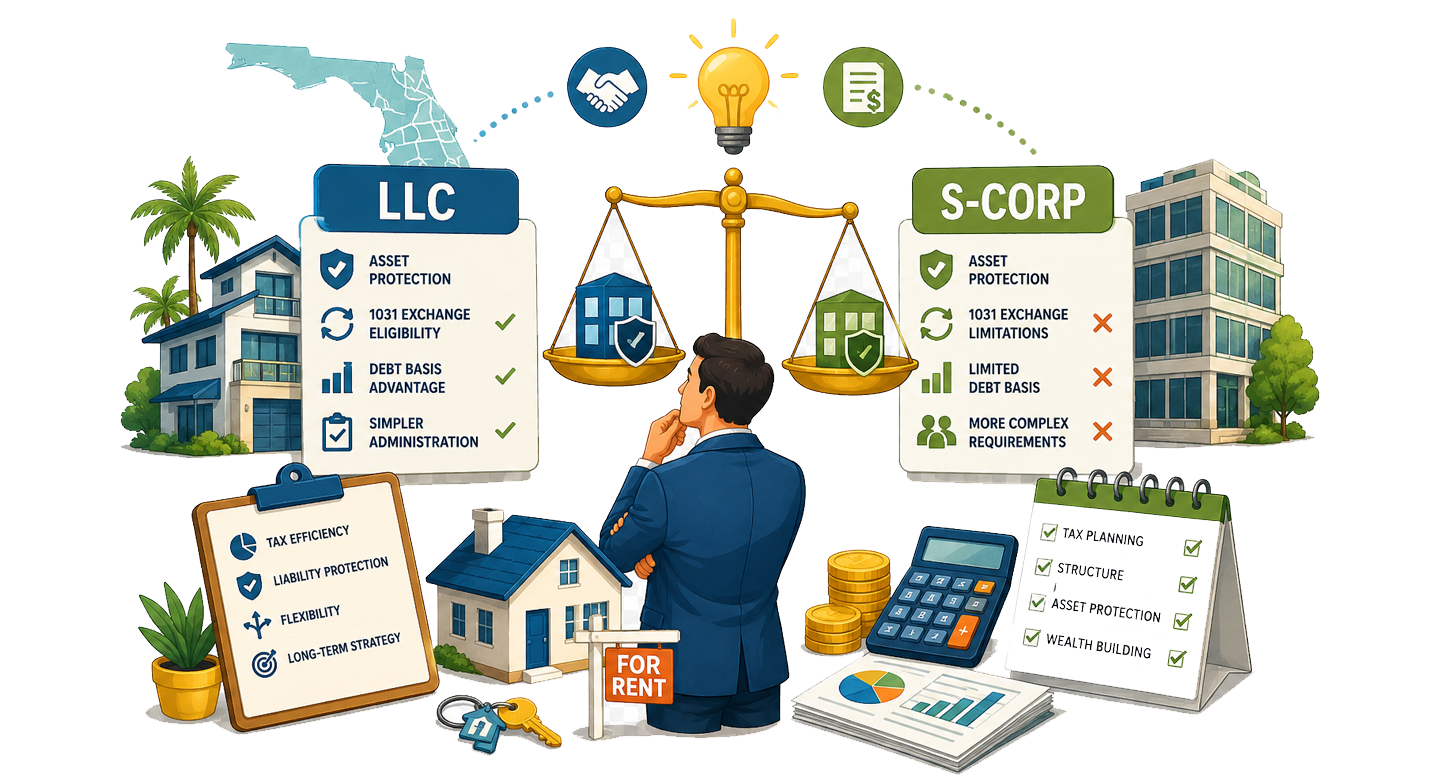
For most Florida real estate investors holding rental properties, an LLC taxed as a partnership is the better structure. It offers superior asset protection, preserves 1031 exchange eligibility, allows debt to increase your tax basis, and is simpler to maintain. S-Corp election makes sense only in specific active-income situations. Here’s how to decide. |
Entity structure is one of the most consequential decisions a real estate investor makes, and the wrong choice can cost thousands in taxes, block a future 1031 exchange, or leave assets exposed for lawsuits. This guide breaks down the differences through a Florida-specific lens, including the new Protected Series LLC law effective July 2026. Link to the entity structure pillar page here. Here is a look at our previous article, The Ultimate Florida Real Estate Investor Tax Planning Guide.
What Is the Core Difference Between an LLC and an S-Corp for Real Estate?
Key Points:
- LLC: A legal entity type. Provides liability protection. By default, taxed as a sole proprietorship (single-member) or partnership (multi-member). Flexible structure with minimal formalities.
- S-Corp: A tax election, not an entity type. You form an LLC (or corporation), then elect S-Corp tax treatment by filing IRS Form 2553. Adds payroll requirements and corporate formalities in exchange for potential self-employment tax savings.
The critical distinction is that an LLC CAN elect S-Corp taxation. These are not mutually exclusive. The question is whether that S-Corp election helps or hurts a real estate investor specifically. Spoiler alert: for passive rental income, it usually hurts.
How Do LLCs and S-Corps Compare for Rental Property?
| Factor | LLC (Partnership Tax) | S-Corp Election |
| Asset Protection | Strong. Separates property from personal assets. Each property can be isolated in its own LLC. | Moderate. Corporate veil exists but does not isolate properties from each other within the same entity. |
| 1031 Exchange Eligibility | Fully eligible. LLC interests can be structured to preserve 1031 exchange rights for members. | Problematic. S-Corp shares are NOT like-kind property. Cannot directly 1031 exchange. Must dissolve entity first, creating taxable events. |
| Debt Basis | Full benefit. Members can include their share of LLC debt in their tax basis, enabling larger loss deductions. | Limited. Shareholders can only increase basis through stock investment or direct loans to the corporation. Entity-level debt does not count. |
| Self-Employment Tax | Passive rental income is NOT subject to SE tax regardless of entity. No disadvantage for rental investors. | Can reduce SE tax on ACTIVE income (flipping, management fees) by splitting salary vs. distributions. No benefit for passive rentals. |
| Section 199A (QBI) Deduction | Available. Rental income can qualify for up to 20% deduction through safe harbor (250+ hours) or trade-or-business test. | Available, but reasonable salary requirement reduces QBI since W-2 wages are excluded from the calculation. |
| Administrative Burden | Low. Annual report filing, basic operating agreement. No payroll requirements. | High. Requires payroll, W-2s, quarterly payroll tax filings, corporate minutes, and reasonable compensation determination. |
| Estate Planning | Flexible. Ownership interests can be transferred via gift or inheritance without triggering tax events. | Restricted. Limited to 100 shareholders, all must be US citizens/residents. No trusts or entities as shareholders (with narrow exceptions). |
| Depreciation & Cost Seg | Full access. 100% bonus depreciation (post-OBBBA) flows through to members. Debt basis allows larger deductions. | Available, but limited basis from debt may restrict how much depreciation a shareholder can deduct. |
Why Is an LLC Usually Better for Holding Rental Properties?
1031 Exchange Preservation
This is the deal-breaker for most investors.
- LLCs: Real property held in an LLC can be 1031 exchanged. Single-member LLCs are disregarded for tax purposes, so the exchange is treated as if the individual owns the property directly.
- S-Corps: S-Corp shares are NOT real property. You cannot 1031 exchange shares. If you want to sell a property held in an S-Corp and defer gains, you must first distribute the property out of the S-Corp, which can itself trigger a taxable event.
- Bottom line: If you ever plan to sell a property and roll gains into a new one, an S-Corp can block that strategy entirely.
Debt Basis Advantage
This is technical but matters enormously for leveraged investors:
- LLC members can include their share of the entity’s debt in their tax basis. If the LLC has a $500K mortgage, that adds to your basis and allows you to deduct losses (depreciation, operating losses) up to that amount.
- S-Corp shareholders cannot count entity-level debt. Only direct loans from the shareholder to the corporation increase basis. This means a leveraged rental portfolio in an S-Corp may generate depreciation deductions the shareholder literally cannot use.
Self-Employment Tax Is a Non-Issue for Passive Rentals
This is the most common misconception for real estate investors:
- The #1 reason people consider S-Corp election is SE tax savings. But passive rental income is NOT subject to self-employment tax in either structure.
- The S-Corp salary/distribution split only saves SE tax on ACTIVE income: flipping profits, property management fees, brokerage commissions.
- If you are a passive landlord collecting rents, the S-Corp election gives you zero SE tax benefit while adding payroll complexity and restricting your basis, 1031 options, and estate planning flexibility.
When Does an S-Corp Election Actually Make Sense for Real Estate?
- Active real estate businesses: If you run a property management company, a real estate brokerage, or a house-flipping operation generating $60K+ in net active income, S-Corp election can save thousands in self-employment taxes through the salary/distribution split.
- High-income active investors: At $250K+ in active real estate income, the SE tax savings from S-Corp election become substantial (potentially $10K-$20K+ annually).
- Combined operations: Some investors hold rentals in LLCs and run their active business (management company, brokerage, flipping entity) as an S-Corp. This is the best-of-both-worlds structure: liability isolation for properties, SE tax savings on active income.
Key point: It is not LLC OR S-Corp. Many sophisticated investors use BOTH, for different parts of their operation. This is where working with a CPA who specializes in real estate makes all the difference.
What Is Florida’s New Protected Series LLC and Why Does It Matter?
Key facts to cover:
- Effective July 1, 2026: Florida’s Protected Series LLC law (Senate Bill 316) allows one parent LLC to create multiple protected series, each with its own assets, liabilities, and liability shield.
- Before this law: Florida investors holding 5 properties needed 5 separate LLCs at $138.75/year each ($693.75 total in annual reports alone). Each with its own EIN, bank account, operating agreement, and registration.
- After this law: One parent LLC with 5 protected series. One annual report ($138.75 total). One EIN possible. Same liability isolation between properties.
- Requirements: Each series must maintain strict separation of records, finances, and operations. Series names must include the parent LLC name plus ‘Protected Series’ or ‘P.S.’ Requires affirmative vote of all members to establish each series.
- The catch: This is a new law with limited case law. Courts have not yet tested the liability shields in Florida. Some attorneys recommend waiting for case law to develop before relying on series LLC protections for high-value portfolios.
We at Cloud Accounting Group are watching this development closely and advising clients on whether and when to transition existing multi-LLC structures to the new Protected Series format.
How Does Entity Choice Affect Depreciation and Cost Segregation?
This is where entity structure meets tax strategy.
- 100% bonus depreciation: The One Big Beautiful Bill Act (signed July 2025) restored 100% first-year bonus depreciation for properties acquired after January 19, 2025. Both LLCs and S-Corps can claim this.
- The basis problem for S-Corps: Even with 100% bonus depreciation available, an S-Corp shareholder may not be able to USE the full deduction if their basis is limited. Entity-level mortgage debt does not increase S-Corp shareholder basis. An investor who buys a $1M property with $200K down and a $800K mortgage in an S-Corp can only deduct losses up to their $200K stock basis, not the full depreciation amount.
- LLC advantage: Same investor in an LLC can include the $800K mortgage in their basis, enabling them to fully utilize the depreciation deduction in year one.
What About the Section 199A Pass-Through Deduction?
- What it is: Up to 20% deduction on qualified business income for pass-through entities (both LLCs and S-Corps).
- 2026 thresholds: Full deduction below approximately $200K (single) or $400K (MFJ). Phase-outs up to $275K single / $550K MFJ.
- Real estate eligibility: Rental income can qualify through the IRS safe harbor (250+ hours of rental services annually with contemporaneous records) or by meeting the Section 162 trade-or-business test.
- S-Corp wrinkle: The reasonable salary you must pay yourself as an S-Corp owner is W-2 income, not QBI. This reduces the pool of income eligible for the 20% deduction. In an LLC, all qualifying income is potentially QBI.
- New minimum deduction: Starting 2026, a guaranteed $400 minimum QBI deduction for those who materially participate with at least $1,000 in QBI.
What Florida-Specific Rules Should Real Estate Investors Know Before Choosing an Entity?
Documentary Stamp Tax on Property Transfers into LLCs
- The trap: Transferring real property into an LLC triggers Florida documentary stamp tax ($0.70 per $100 of consideration in all counties except Miami-Dade, which is $0.60). Many investors assume transferring a property they already own into their own LLC is tax-free. It is not always.
- Mortgage matters: If you transfer a property with an outstanding mortgage into a wholly-owned LLC, documentary stamp tax is owed on the unpaid mortgage balance. A $400K mortgage means $2,800 in documentary stamp tax. Transfers of unencumbered property to a wholly-owned entity may be exempt.
- The 3-year rule: If you transfer property into an LLC and then transfer any membership interest in that LLC within 3 years, documentary stamp taxes may be imposed on the equity transfer. This catches investors who plan to bring in partners after forming the entity.
- Planning opportunity: Structure your entity BEFORE acquiring the property whenever possible. When the LLC buys the property directly, there is no transfer and no extra documentary stamp exposure. This requires planning ahead, which is where a CPA adds value.
Florida’s Strong Charging Order Protection
- What it means: Under Florida Statute 605.0503, a creditor who wins a judgment against you personally cannot seize your LLC membership interest. The creditor’s sole and exclusive remedy is a charging order, which only entitles them to distributions IF the LLC makes any. They cannot force distributions, vote, inspect records, or manage the LLC.
- Multi-member vs. single-member: This is a critical distinction. Multi-member Florida LLCs get exclusive charging order protection; the creditor literally cannot foreclose on the membership interest. Single-member LLCs have weaker protection; under Section 605.0503(4), a court CAN order foreclosure of a single-member LLC interest if the charging order will not satisfy the judgment in reasonable time.
- Practical takeaway: For maximum asset protection, many Florida attorneys recommend multi-member LLCs (even adding a spouse or trust as a 1-2% member) to activate the stronger exclusive charging order protection. This is a Florida-specific advantage not available in many other states.
Homestead Exemption and Entity Ownership
- The rule: Properties titled in an LLC’s name do NOT qualify for Florida’s homestead exemption, even if you are the sole member and live in the property full-time. The property must be titled in a natural person’s name.
- For investors: This matters primarily if you ever consider living in one of your investment properties. Keep your primary residence in your personal name (or a properly structured revocable trust) to preserve homestead protections. Investment and rental properties go in LLCs.
A common mistake we see is that investors who move an older rental into their personal use sometimes leave it in the LLC and lose the homestead exemption without realizing it.
LLC Formation Basics Through Sunbiz
- Filing: File Articles of Organization through the Florida Division of Corporations at Sunbiz (dos.fl.gov/sunbiz). Online filing costs $125 ($100 filing fee + $25 registered agent fee). Processing takes 1-3 business days online.
- Registered agent: Must have a physical Florida street address (no P.O. boxes). The LLC cannot serve as its own registered agent, but a member or manager can.
- Annual report: $138.75 due annually by May 1. Late fee of $400 is automatic. This is filed through Sunbiz.
- Operating agreement: Not filed with the state but essential for multi-member LLCs and asset protection. Defines member rights, distribution policies, and management structure.
How Should a Florida Real Estate Investor Structure Their Portfolio?
Recommended structure by investor type:
| Investor Type | Recommended Structure | Why |
| Passive landlord (1-3 properties) | Single-member LLC per property (or Protected Series LLC after July 2026) | Simplicity, liability isolation, full 1031 access, pass-through taxation, no payroll burden |
| Portfolio investor (4+ properties) | Parent LLC holding company + individual LLCs or Protected Series per property | Scalable liability isolation. Protected Series reduces admin costs. Preserves all tax benefits. |
| Active flipper / wholesaler | S-Corp for the flipping business + separate LLCs for any rental holds | SE tax savings on active flipping income. Rental properties kept in LLCs to preserve 1031 eligibility and basis benefits. |
| Property management operator | S-Corp for management company + LLCs for owned properties | Management fees are active income; S-Corp saves SE tax. Owned properties stay in LLCs for asset protection and flexibility. |
| Syndication sponsor / GP | Multi-member LLC for each deal + S-Corp for sponsor entity | LLC required for investor pass-through. Sponsor entity as S-Corp saves SE tax on management/acquisition fees. |
Every situation is different. The right structure depends on your income level, growth plans, whether your income is active or passive, and your long-term exit strategy. This is exactly the kind of analysis that Cloud Accounting Group provides to Florida real estate investors.
FAQ Section
Can I 1031 exchange a property held in an S-Corp?
Answer: Not directly. S-Corp shares are not real property and do not qualify for 1031 exchanges. You would need to distribute the property out of the S-Corp first, which may trigger taxable events. LLCs, especially single-member LLCs, preserve 1031 exchange eligibility much more cleanly.
Does an S-Corp save self-employment tax on rental income?
Answer: No. Passive rental income is not subject to self-employment tax regardless of entity type. The S-Corp salary/distribution split only saves SE tax on active income like flipping profits, management fees, or brokerage commissions. For passive landlords, S-Corp election adds complexity with no SE tax benefit.
What is Florida’s new Protected Series LLC?
Answer: Effective July 1, 2026, Florida law allows one parent LLC to create multiple protected series, each with separate assets and liability shields. For real estate investors, this means one entity with internal liability walls between properties, reducing filing fees and administrative burden versus maintaining separate LLCs.
Can I convert my S-Corp to an LLC to hold rental property?
Answer: Yes, but the conversion may trigger tax consequences depending on built-in gains, appreciated property values, and existing liabilities. This requires careful planning with a CPA to minimize the tax impact. It is often worth the short-term cost for long-term structural benefits.
How many LLCs do I need for a real estate portfolio in Florida?
Answer: Ideally, one LLC per property for maximum liability isolation. After July 2026, Florida’s Protected Series LLC lets you achieve this with one parent entity containing multiple protected series, significantly reducing costs and administrative overhead compared to maintaining separate LLCs.
LLC vs. S Corp for Real Estate Investors
LLCs are meant for properties, while S-Corps, generally, are for active income entities. The Protected Series LLC is an opportunity every real estate investor should be looking at come July 1st. Don’t forget to check out The Ultimate Florida Real Estate Investor Tax Planning Guide for more in-depth information on real estate in Florida.
Cloud Accounting Group specializes in helping Florida real estate investors structure their entities for maximum tax efficiency and asset protection. Click here to book a free tax strategy call with one of our experts.