
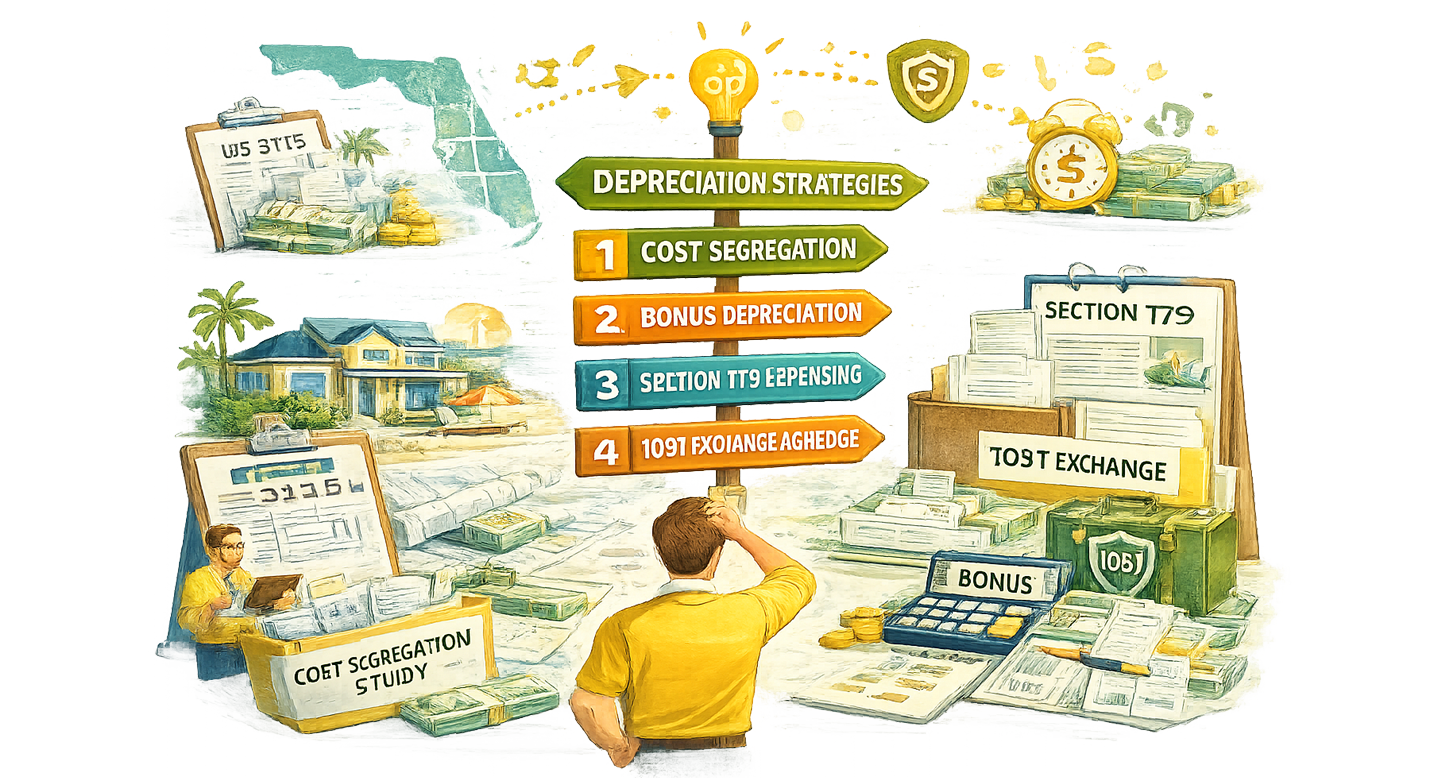
As a Florida rental property investor, depreciation is one of the few areas of the tax code that can actively work in your favor. Essentially, it can serve as a built-in annual deduction that reduces taxable income without touching cash flow.
You might already know about this option and still choose to take the standard deduction.
While this can benefit you, there are several depreciation strategies that may serve you and your portfolio far better. These allow you to accelerate deductions, reduce what you owe at sale, and, over time, truly maximize what your properties can do.
If you’d like a full walkthrough on tax planning as a whole, see our guide to Florida real estate investor tax strategies. Otherwise, read on to learn about four of the most effective depreciation strategies for rental properties.
How the 27.5-Year Depreciation Schedule Works
The IRS allows rental property owners to deduct a property’s cost over its useful life per Publication 527, which is currently set at 27.5 years for residential rentals and 39 years for commercial properties.
On a $300,000 depreciable basis (excluding land), that’s roughly $10,900 in annual deductions that reduce taxable income without touching cash flow. For Florida investors, every dollar applies directly to the federal return—no state income tax layer to complicate the math.
But there are two things investors frequently get wrong before they ever file:
- Land vs. building allocation – Land can’t be depreciated. At purchase, the total price must be split between land value and the structure. Overstating the land portion permanently shrinks the depreciable base.
- The placed-in-service date – Depreciation starts when a property is ready and available for rent, not when a tenant signs a lease. As long as the property is available, you can claim depreciation even during vacancies.
With these fundamentals clarified, let’s now cover the top four depreciation strategies for Florida rental property investors.
What happens if I forget to claim depreciation?
The IRS applies depreciation recapture at sale based on what should have been claimed, not just what was claimed. So, skipping depreciation doesn’t avoid the tax; it means you pay recapture without ever getting the deduction’s benefit.
Investors who have missed years of depreciation can often recover those deductions by filing IRS Form 3115, which requests a change in accounting method.
It’s one of the most expensive errors in rental property ownership, but know that in most cases, it’s retroactively fixable.
1. Front-Loading Your Deductions with Cost Segregation
Standard depreciation spreads your deductions evenly over 27.5 or 39 years. Cost segregation changes the distribution.
An engineering-based study reclassifies components of a rental property (like flooring, cabinetry, specialty lighting, paved areas, landscaping, and pools) from the standard building schedule into shorter 5-, 7-, and 15-year depreciation lives.
The result is significantly larger deductions in the early years of ownership, when they have the most impact on cash flow.
On average, 20% to 40% of a property’s depreciable basis can be reclassified. On a $1 million Florida rental property, that’s $200,000 to $400,000 in accelerated deductions available in the near term.
But the timing is critical. Earlier in ownership is better, but cost segregation can also be applied retroactively through a look-back study using Form 3115. If you purchased a property several years ago without commissioning a study, you likely haven’t missed the window.
For a complete breakdown of how this strategy works in practice, including which components qualify and what the process involves, see our guide to cost segregation for Florida real estate investors.
Is a cost segregation study worth it for Florida investors?
For most Florida investors with properties valued above $500,000, yes. A study typically generates deductions that far exceed its cost.
You see, Florida rental properties tend to have strong reclassification rates due to features like pools, paved parking, and, for short-term rentals, high-value furnishings and specialty fixtures.
On a $1 million property, even a conservative 25% reclassification rate means $250,000 in accelerated deductions. Before commissioning a study, a CPA can run a preliminary analysis to estimate whether the numbers make sense for your specific property.
2. Bonus Depreciation Under the One Big Beautiful Bill Act
Bonus depreciation allows investors to deduct qualifying assets immediately in the year they’re placed in service, rather than spreading them across a 5-, 7-, or 15-year schedule.
Paired with a cost segregation study, the combination produces the largest possible first-year deduction.
As of 2026, the One Big Beautiful Bill Act permanently reinstated bonus depreciation at 100% for qualifying property placed in service after January 19, 2025. This reverses the phase-down that had been gradually reducing the available rate under prior law, and it’s a significant change for Florida investors who had adjusted their expectations downward.
However, know that the 100% rate applies to reclassified personal property and land improvements—not the building structure itself.
The structure still depreciates over 27.5 or 39 years. Cost segregation is what identifies which portions of the property can access this benefit.
There’s also a transition rule worth knowing, which is that property acquired under a binding written contract before January 19, 2025, may qualify for only 20% bonus depreciation. The acquisition date determines which rules apply.
What are the current bonus depreciation rules?
As of 2026, bonus depreciation is permanently set at 100% for qualifying property placed in service after January 19, 2025, under the One Big Beautiful Bill Act. This applies to personal property and land improvements, not the building structure itself.
Property acquired under a binding written contract before January 19, 2025, may qualify for only 20% under transition rules. Confirm your acquisition date with a CPA before filing.
3. Classifying Improvements and Repairs Properly
You’ll have the opportunity to choose between repair and capital improvement dozens of times over the entire life of a rental property. But if you’re not careful, it’s easy to make a misstep here.
What you need to know is that repairs restore a property to its prior condition and are deducted in the current year.
Capital improvements, on the other hand, add value, extend useful life, or adapt the property for a new use. Said another way, they must be capitalized and depreciated, or potentially accelerated through bonus depreciation.
The most common misclassifications include:
- Repainting a room after tenant move-out (repair) vs. repainting the full exterior (improvement)
- Replacing a few broken roof tiles (repair) vs. replacing the entire roof (improvement)
- Fixing an HVAC component (repair) vs. installing a new system (improvement)
For investors in Martin County, or anywhere across Florida’s coastal markets, hurricane-resistant upgrades such as impact windows, storm shutters, and roof reinforcement tend to fall in a gray area. They’re generally capital improvements, not repairs, which means they should be capitalized and may qualify for accelerated depreciation.
Getting it wrong in either direction creates a problem for you, which is why it’s so important to have a clear understanding of your options. Expensing an improvement is a compliance risk; capitalizing a repair means overpaying taxes you didn’t owe.
What is the difference between repairs and capital improvements?
A repair restores a rental property to its prior condition without adding lasting value, for example, patching a leak, replacing a broken window pane, or fixing a plumbing line.
A capital improvement adds value, extends useful life, or adapts the property for a new use, such as roof replacement, kitchen renovation, or full HVAC installation.
Repairs are deducted in the current year. Improvements are capitalized and depreciated, though qualifying improvements may be eligible for accelerated deduction through bonus depreciation.
4. Leveraging Depreciation Recapture Before You Sell
For most rental property investors, it’s common not to think about depreciation recapture until preparing to sell. Unfortunately, that’s too late to plan.
When you sell, the IRS recaptures the depreciation you claimed during ownership and taxes it at up to 25% under Section 1250—separate from the capital gains rate on the rest of your profit.
But that’s not all. Two specific, little-known factors make this more complicated than most investors expect.
First is the missed depreciation trap. Recapture is calculated on the depreciation that should have been taken, not just what was claimed. Investors who skipped depreciation to simplify their bookkeeping still owe recapture at sale, without ever having received the benefit.
Second is the 1031 exchange deferral. A properly executed 1031 exchange defers both capital gains and depreciation recapture into the replacement property. To be clear, the tax doesn’t disappear; it follows the property. But it can be pushed forward indefinitely with proper planning.
If you’re a long-term holder, you should also know about the stepped-up basis benefit. Heirs who inherit a property receive it at the current market value, which effectively resets the accumulated recapture.
The best time to plan around recapture is years before you’re ready to sell. Our real estate investor tax planning services are built for exactly this kind of forward-looking strategy.
What is depreciation recapture when selling a rental property?
Depreciation recapture is the tax the IRS collects on the depreciation deductions you took during ownership, and it happens when you sell.
Under Section 1250, recaptured depreciation is taxed at a maximum rate of 25%, separate from the capital gains rate on the rest of your profit. The IRS calculates recapture on depreciation that should have been taken, not just what was claimed.
A 1031 exchange can defer recapture indefinitely, and inherited properties receive a stepped-up basis that resets the calculation entirely.
If You’ve Left Deductions on the Table, It’s Not Too Late
While the strategies we’ve shared here can be incredibly effective, reading about them can also be stressful. Suddenly, you might find yourself wondering how many years of depreciation you’ve missed, or what might’ve changed if you’d commissioned a cost segregation study years ago.
At Cloud Accounting Group, we specialize in serving real estate investors across Florida. If you’re ready to learn more about how to maximize deductions through depreciation strategies, book your free discovery call with our experts today.
Frequently Asked Questions About Depreciation Strategies for Florida Rental Property Investors
What happens if I forget to claim depreciation?
The IRS applies depreciation recapture at sale based on what should have been claimed, not just what was claimed. So, skipping depreciation doesn’t avoid the tax; it means you pay recapture without ever getting the deduction’s benefit.
Investors who have missed years of depreciation can often recover those deductions by filing IRS Form 3115, which requests a change in accounting method.
It’s one of the most expensive errors in rental property ownership, but know that in most cases, it’s retroactively fixable.
Is a cost segregation study worth it for Florida investors?
For most Florida investors with properties valued above $500,000, yes. A study typically generates deductions that far exceed its cost.
You see, Florida rental properties tend to have strong reclassification rates due to features like pools, paved parking, and, for short-term rentals, high-value furnishings and specialty fixtures.
On a $1 million property, even a conservative 25% reclassification rate means $250,000 in accelerated deductions. Before commissioning a study, a CPA can run a preliminary analysis to estimate whether the numbers make sense for your specific property.
What are the current bonus depreciation rules?
As of 2026, bonus depreciation is permanently set at 100% for qualifying property placed in service after January 19, 2025, under the One Big Beautiful Bill Act. This applies to personal property and land improvements, not the building structure itself.
Property acquired under a binding written contract before January 19, 2025, may qualify for only 20% under transition rules. Confirm your acquisition date with a CPA before filing.
What is the difference between repairs and capital improvements?
A repair restores a rental property to its prior condition without adding lasting value, for example, patching a leak, replacing a broken window pane, or fixing a plumbing line.
A capital improvement adds value, extends useful life, or adapts the property for a new use, such as roof replacement, kitchen renovation, or full HVAC installation.
Repairs are deducted in the current year. Improvements are capitalized and depreciated, though qualifying improvements may be eligible for accelerated deduction through bonus depreciation.
What is depreciation recapture when selling a rental property?
Depreciation recapture is the tax the IRS collects on the depreciation deductions you took during ownership, and it happens when you sell.
Under Section 1250, recaptured depreciation is taxed at a maximum rate of 25%, separate from the capital gains rate on the rest of your profit. The IRS calculates recapture on depreciation that should have been taken, not just what was claimed.
A 1031 exchange can defer recapture indefinitely, and inherited properties receive a stepped-up basis that resets the calculation entirely.