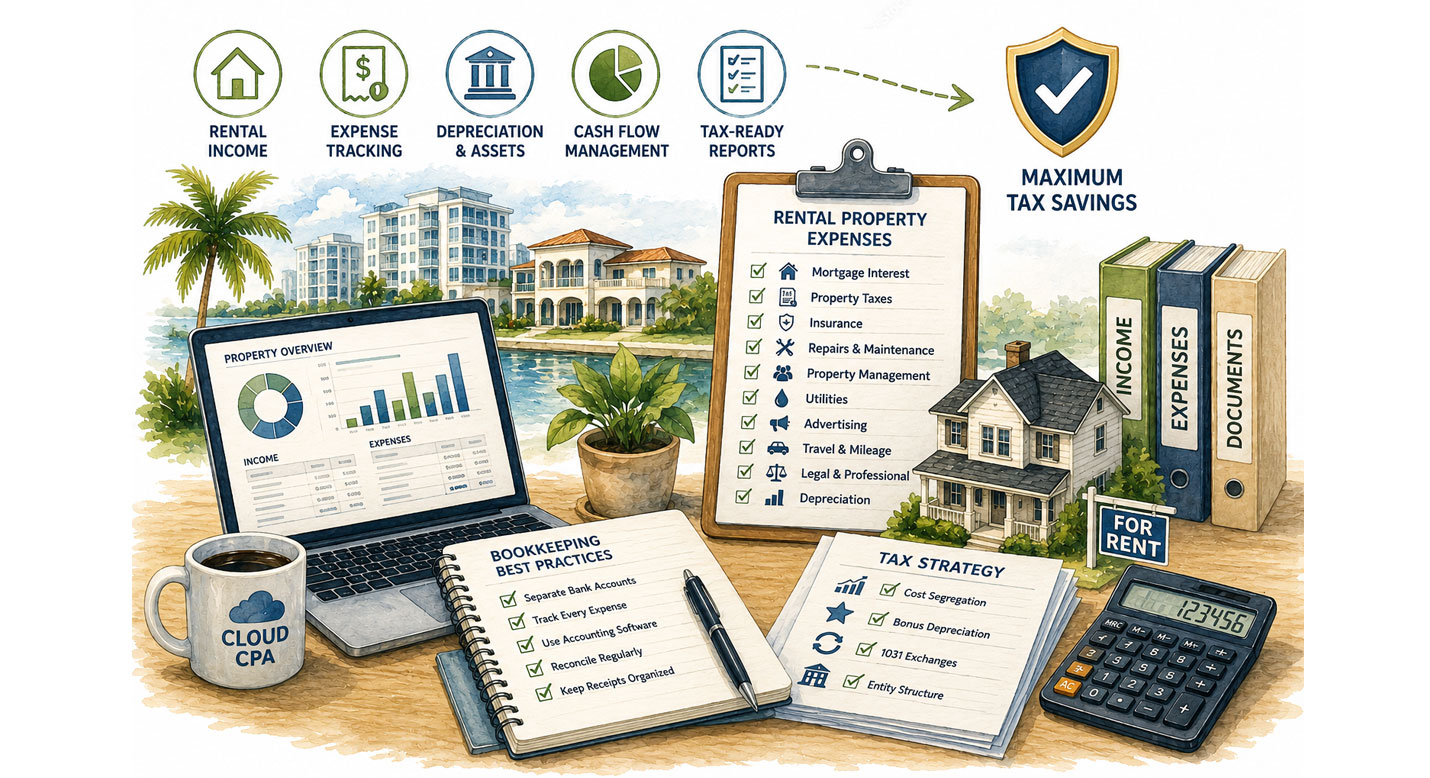
To set up your real estate books for maximum tax savings, separate every property and entity into its own records, run all income and expenses through dedicated bank accounts, track each property individually in cloud software like Xero or QBO, distinguish repairs from improvements correctly, and keep a depreciation schedule plus contemporaneous time logs. Clean books turn earned deductions into defensible tax savings.
Bookkeeping is the least glamorous part of real estate investing and the part that quietly decides how much tax you pay. Every deduction you claim like depreciation, mortgage interest, repairs, mileage, cost segregation, etc., only survives if the documentation behind it does. Whether you own rentals in Jacksonville, flip houses in Tampa, run short-term rentals in Orlando, or hold commercial property in Miami, the strategies that save the most money (your entity structure, 1031 exchanges, and real estate professional status) all rest on the same foundation: books that are clean, current, and organized by property. This guide shows you how to build that foundation.
Why Does Bookkeeping Determine How Much Tax a Real Estate Investor Pays?
Bookkeeping determines your tax bill because the IRS does not give you credit for deductions you cannot document. You can be entitled to a $40,000 depreciation deduction or a write-off for a new roof, but if your records are a shoebox of receipts and a commingled checking account, those deductions become fragile. Disallowed deductions are exactly what turns a routine audit into a painful one.
Good books do three things at once. They capture every legitimate deduction so nothing is left on the table, they produce property-level profit and loss reports your CPA needs to plan proactively, and they protect the liability shield your LLC was formed to provide. The moment you commingle personal and business funds, you hand a creditor or the IRS a reason to argue your entity is a sham. Clean books are both a tax strategy and an asset-protection strategy.
How Should You Structure Your Real Estate Books From Day One?
Set up your books the same way you set up your entities: one property (or one LLC) at a time, with hard walls between them. Florida’s strong charging order protection and the new Protected Series LLC law (effective July 1, 2026) only deliver their full benefit when each property’s finances are genuinely separate. Your bookkeeping is the proof that the separation is real.
Open a Dedicated Bank Account for Each Entity
Every LLC should have its own business checking account and, ideally, its own credit card. Rent flows in, property expenses flow out, and nothing personal ever touches it. This single habit eliminates the most common audit red flag in real estate: commingling. It also makes your monthly reconciliation fast instead of forensic. If you own five properties across five LLCs in Fort Lauderdale and Sarasota, you should have five bank accounts by design.
Track Every Dollar by Property
Even when properties share an entity, track income and expenses by property. Property-level reporting tells you which rental is actually making money, isolates one property’s records if it is ever audited, and makes tax preparation dramatically faster and cheaper. Modern software handles this with tracking categories or classes, so you get clean per-property profit and loss without maintaining separate ledgers by hand.
What Belongs in a Real Estate Investor’s Chart of Accounts?
Your chart of accounts is the skeleton of your books. A real estate chart of accounts should separate income, operating expenses, and capitalized assets so that deductible costs and depreciable costs never get mixed together. Here’s a practical starting structure.
| Category | Accounts to Include |
|---|---|
| Income | Rental income, short-term rental income, late fees, application/pet fees, other income |
| Operating Expenses | Mortgage interest, property tax, insurance, repairs & maintenance, utilities, property management fees, advertising, HOA dues, professional fees, bank/merchant fees |
| Auto & Travel | Mileage, travel to and from properties |
| Capitalized Assets | Building, land (non-depreciable), improvements, appliances, furniture & fixtures |
| Liabilities | Mortgage payable, security deposits held, sales tax payable, tourist development tax payable |
| Equity | Owner contributions, owner distributions |
Note: Land sits in its own account because it is never depreciable, and security deposits and collected taxes are liabilities, not income. These are two distinctions investors get wrong constantly.
Repairs vs. Improvements: How Should You Categorize Them?
This is the single most consequential categorization in real estate bookkeeping. A repair is deductible in full this year; an improvement must be capitalized and depreciated (or accelerated through bonus depreciation). Misclassify it, and you either overpay now or face an amended return and recapture later.
| Treatment | Repairs (Deduct Now) | Improvements (Capitalize & Depreciate) |
|---|---|---|
| Definition | Keeps the property in ordinary working condition | Betters, restores, or adapts the property to a new use |
| Examples | Patching a roof, fixing a leak, repainting, replacing a broken appliance part, servicing HVAC | Replacing the roof, renovating a kitchen, new HVAC system, room addition, new flooring throughout |
| Tax effect | Fully deductible in the current year | Depreciated over 5–39 years; may qualify for 100% bonus depreciation |
| Bookkeeping home | Repairs & maintenance expense | Fixed asset / capital improvement account |
When an improvement is large, a cost segregation study can reclassify components into 5-, 7-, and 15-year lives. Now, under the One Big Beautiful Bill Act, qualifying property placed in service after January 19, 2025 is eligible for 100% first-year bonus depreciation. Your books need to capture the asset cleanly so your CPA can run that analysis.
How Do You Keep a Depreciation Schedule That Maximizes Deductions?
Maintain a depreciation schedule that lists every property and capital asset, its placed-in-service date, cost basis (with land separated out), method, and accumulated depreciation. Residential rentals depreciate over 27.5 years and commercial over 39 years, but a cost segregation study layered with bonus depreciation can front-load enormous deductions into year one.
Two mistakes cost investors the most here. First, allocating too much of a purchase price to land, which permanently shrinks your depreciable base. Use the county property appraiser’s land-to-building ratio as defensible support.
Second, skipping depreciation to simplify bookkeeping. The IRS recaptures depreciation at up to 25% under Section 1250 when you sell, whether or not you ever claimed it, so skipping it means you absorb the cost without ever getting the benefit. Update the schedule with every acquisition, improvement, and disposition.
What Records Do You Need to Protect REPS and Other High-Value Deductions?
If you claim real estate professional status or material participation in a short-term rental, your bookkeeping must include a contemporaneous time log, which is a record kept in real time, not reconstructed at filing. The Tax Court consistently rejects reconstructed logs and accepts contemporaneous ones. Each entry should show the date, property, activity description, and hours.
Back the log with corroborating documentation that lives in your books: emails and texts with tenants and contractors, invoices tied to dates, calendar entries, and mileage logs. Mileage to and from your properties across metros like Stuart, Naples, and Jacksonville adds up to a real deduction, but only with a contemporaneous log. The investors who win REPS audits have records kept from January 1; the ones who lose try to rebuild them in April.
What Florida-Specific Bookkeeping Rules Should Investors Track?
National bookkeeping advice misses several Florida-specific items that flow directly through your books, especially for short-term rental operators.
Short-Term Rental Tax Collection and Remittance
Rentals of six months or less are subject to Florida’s 6% state sales tax, plus county discretionary surtaxes, plus a local Tourist Development Tax (TDT) ranging from roughly 2% to 6.5% depending on the county. Airbnb and VRBO typically remit state sales tax automatically, but TDT on direct bookings is often the host’s responsibility. Track collected taxes as a liability, never as income, and reconcile what platforms remit versus what you owe directly so nothing slips through.
Closing Costs, Documentary Stamp Tax, and Basis
Florida documentary stamp tax ($0.70 per $100, or $0.60 in Miami-Dade) and other closing costs are not all immediately deductible. Many are capitalized into the property’s basis. Record them correctly at acquisition so your basis and your future depreciation and gain calculations start accurately.
Security Deposits and Insurance
Security deposits are a liability you are holding, not rental income, until you apply them. And because Florida insurance premiums are volatile, tracking insurance by property, a wind-mitigation-driven premium drop, or a mid-year increase changes each property’s real cash flow and your tax picture.
What Software and Workflow Should You Use to Keep Books Tax-Ready?
The right software makes property-level bookkeeping workable at any portfolio size. At Cloud Accounting Group, we use Xero as our primary platform because it delivers real-time reporting and integrates with property management tools, so your books stay current without constant manual entry. For Airbnb and VRBO operators, tools like BnbTally connect reservation data directly into Xero and import bookings automatically.
Build a simple monthly rhythm: reconcile every bank and credit card account, categorize transactions by property, confirm repairs versus improvements as you go, log mileage and participation hours, and review a per-property profit and loss. A monthly close of fifteen minutes per property prevents the year-end scramble that causes missed deductions.
What Are the Most Common Bookkeeping Mistakes That Cost Investors Money?
The most expensive errors are ordinary ones that compound year after year:
- Commingling personal and business funds, which voids liability protection and triggers audit scrutiny.
- Misclassifying improvements as repairs (or the reverse), distorting current versus capitalized deductions.
- Skipping depreciation, which the IRS recaptures whether or not you claimed it.
- Reconstructing time logs at tax time instead of keeping them contemporaneously, sinking REPS and STR claims.
- Treating security deposits or collected sales tax as income, overstating profit and creating compliance gaps.
- Not tracking by property, making it impossible to see which rentals perform or to produce CPA-ready reports.
Nearly all of these disappear when the right system is in place before you buy your next property.
Frequently Asked Questions
Should each rental property have its own separate bookkeeping?
Yes. Tracking income and expenses by property is one of the most important habits an investor can build. It lets you calculate accurate profit per property, identify underperformers, isolate records if one property is audited, and hand your CPA clean property-level reports. Modern software like Xero makes per-property tracking simple even for small portfolios.
What accounting software is best for real estate investors?
Cloud platforms that support property-level tracking work best. Cloud Accounting Group uses Xero for its real-time reporting and integrations with property management tools. Short-term rental hosts can connect Airbnb and VRBO data through tools like BnbTally, which imports reservations into Xero automatically and reduces manual entry across the portfolio.
How do I categorize repairs versus improvements?
Repairs keep a property in ordinary working condition and are fully deductible now, including patching a roof, fixing a leak, and repainting. Improvements like a new roof, kitchen renovation, or full re-flooring must be capitalized and depreciated, though they may qualify for 100% bonus depreciation. Misclassifying either creates costly errors.
Can poor bookkeeping trigger an IRS audit for real estate investors?
Poor bookkeeping does not automatically trigger an audit, but it raises your exposure and weakens you if one occurs. Red flags include large deduction-to-income ratios, cash-heavy income with thin documentation, and commingled accounts. If audited, inadequate records mean legitimate deductions get disallowed, because the IRS gives no credit for expenses you cannot document.
How do I track expenses for short-term rentals in Florida?
Track rental income, platform fees, and operating costs by property, and record collected sales tax and Tourist Development Tax as liabilities rather than income. Florida short-term rentals owe 6% state sales tax, county surtaxes, and local TDT of roughly 2%–6.5%. Airbnb and VRBO often remit state tax, but direct-booking TDT is frequently the host’s responsibility.
Do I need to track mileage as a real estate investor?
Yes, if you want the deduction. Driving to inspect properties, meet contractors, or handle tenant issues is deductible, but only with a contemporaneous mileage log showing date, destination, purpose, and miles. These hours can also support real estate professional status. Reconstructing mileage at year-end is far weaker than logging it in real time.
When should I hire a bookkeeper or CPA for my real estate portfolio?
Consider professional help once you own multiple properties, mix short-term and long-term rentals, or plan a 1031 exchange or cost segregation study. A real estate-focused CPA catches strategies a generalist misses and keeps your books structured for them. For most growing Florida portfolios, the savings captured outweigh the cost many times over.
Build Books That Defend Every Deduction You Earn
Maximum tax savings in real estate are not won in April; they are won by the systems you set up before you buy. Separate entities and bank accounts, property-level tracking, correct repair-versus-improvement calls, a current depreciation schedule, and contemporaneous logs are what let strategies like 1031 exchanges, cost segregation, and real estate professional status actually deliver. The bookkeeping is the foundation everything else stands on.
At Cloud Accounting Group, Tony Tropeano, CPA, brings 15 years of real estate tax experience, and Nik Watson, our CEO and EA, brings an operator’s lens to building systems that scale. We help investors in Stuart, Miami, Tampa, Orlando, Jacksonville, and throughout Florida set up books that keep more of their wealth. Schedule your free consultation call today.
This article is for educational purposes only and does not constitute legal or tax advice. Consult a licensed CPA or EA before implementing any strategy described here. Every investor’s situation is unique, and the right approach depends on your specific facts and circumstances.