Year-end tax planning gives Florida real estate investors an opportunity to review income, expenses, depreciation, property purchases and sales, and other tax decisions before the year closes. Reviewing these items with a tax professional before December 31 can uncover planning opportunities, correct bookkeeping problems, and help investors prepare for the coming tax year.
Tax preparation tells you what happened. Tax planning gives you an opportunity to make informed decisions before the year is over.
For rental property owners, those decisions can involve far more than gathering receipts. Depreciation, cost segregation, passive activity losses, property improvements, entity structure, estimated taxes, and the timing of property purchases or sales can all affect an investor’s tax position.
Use the following year-end checklist to identify areas that deserve attention before closing the books.
Why Should Florida Real Estate Investors Do Tax Planning Before Year-End?
Real estate investors should review their tax position before year-end because some planning opportunities depend on actions taken during the tax year, while others require preparation before a transaction occurs.
Waiting until tax preparation season can mean discovering opportunities after there is little or no time left to act.
Year-end planning should generally include a review of:
- Rental income and expenses
- Bookkeeping accuracy
- Depreciation schedules
- Repairs and capital improvements
- Property acquisitions and dispositions
- Passive activity losses
- Material participation
- Real Estate Professional Status
- Estimated tax payments
- Short-term rental activity
- Potential 1031 exchanges
- Plans for the following year
Year-end planning should also be viewed as one part of a larger strategy. Our Ultimate Florida Real Estate Investor Tax Planning Guide explains how these individual strategies fit together throughout the life of a real estate investment.
1. Are Your Rental Property Books Accurate and Up to Date?
Accurate bookkeeping is the foundation of effective tax planning. Before evaluating advanced tax strategies, investors should know how each property actually performed during the year.
Start by making sure all rental income and expenses have been entered and that bank and credit card accounts have been reconciled.
Review items such as:
- Rental income
- Management fees
- Mortgage interest
- Property taxes
- Insurance
- HOA expenses
- Utilities
- Repairs and maintenance
- Legal and accounting expenses
- Advertising
- Cleaning
- Landscaping
- Travel and transportation expenses
- Owner contributions and distributions
Pay particular attention to transactions that may have been paid personally instead of through the property’s bank account. A legitimate rental expense can be easy to overlook when it never appears in the property’s bookkeeping system.
Investors with several properties should also make sure income and expenses are being tracked by property rather than combining everything into one undifferentiated set of books.
For a more detailed accounting system, see Real Estate Investor Bookkeeping: How to Set Up Your Books for Maximum Tax Savings.
2. Have You Identified All Potential Rental Property Deductions?
Rental property owners can generally deduct ordinary rental expenses subject to applicable tax rules and limitations. Common categories can include mortgage interest, property taxes, insurance, management fees, repairs, maintenance, professional fees, utilities, advertising, and certain transportation or travel expenses.
The important part of year-end planning is not simply finding more expenses. It is making sure legitimate expenses have been captured, documented, and classified correctly.
Review your general ledger and ask:
- Are any property expenses still sitting on personal credit cards?
- Were professional fees properly recorded?
- Were insurance and property tax payments entered correctly?
- Are management fees accounted for?
- Were qualifying travel or vehicle expenses documented?
- Were repairs recorded separately from improvements?
- Did you purchase equipment, furniture, appliances, or other assets during the year?
Cloud Accounting Group’s upcoming Ultimate Guide to Rental Property Tax Deductions for Florida Real Estate Investors will examine individual deduction categories in greater detail.
3. Have You Properly Classified Repairs and Improvements?
One of the most important year-end reviews is determining whether property expenditures were repairs or capital improvements.
The distinction matters because a qualifying repair may generally be deductible as an expense, while an improvement generally must be capitalized and recovered through depreciation.
An expenditure may be considered an improvement when it results in a betterment, restoration, or adaptation of the property to a new or different use.
For example, repairing a small damaged section of a roof may receive different tax treatment from replacing the entire roof.
Do not assume that every large expenditure is automatically an improvement or that every small expenditure is automatically a repair. The tax treatment depends on the applicable rules and the facts surrounding the work.
Certain taxpayers may also qualify for elections or safe harbors under the tangible property regulations, including the de minimis safe harbor, safe harbor for small taxpayers, and routine maintenance safe harbor.
This is an area worth reviewing with your CPA before filing your return.
4. Have You Reviewed the Depreciation Schedule for Every Property?
Depreciation is one of the most important tax benefits associated with owning income-producing real estate.
Rental property generally begins being depreciated when it is ready and available for rent, or “placed in service.” The amount of depreciation depends on factors including the property’s depreciable basis, applicable recovery period, and depreciation method.
At year-end, investors should review:
- Properties acquired during the year
- Placed-in-service dates
- Allocation between land and depreciable property
- Building basis
- Improvements
- Furniture
- Appliances
- Equipment
- Assets replaced or disposed of
- Existing depreciation schedules
This review is particularly important because failing to claim depreciation does not necessarily preserve the deduction for later. Tax basis generally must still be reduced by depreciation that was allowable, even when the taxpayer failed to claim it.
For additional planning opportunities, see Four Depreciation Strategies for Florida Rental Property Investors.
5. Should You Consider a Cost Segregation Study?
Cost segregation can accelerate depreciation by identifying portions of a property that may qualify for shorter recovery periods than the building itself.
That can create larger depreciation deductions earlier in the investment period, although the benefit depends heavily on the property, the investor’s tax situation, current depreciation rules, and future plans for the asset.
Year-end is a good time to identify:
- Properties acquired during the year
- Recently renovated properties
- Existing properties that have never been evaluated
- Properties expected to generate significant taxable income
- Investors whose tax circumstances have changed
Cost segregation should not be viewed simply as a way to create the largest possible current deduction. Accelerating deductions can affect future depreciation and the tax consequences when property is sold.
Read Cost Segregation for Florida Real Estate Investors for a deeper explanation of how the strategy works.
6. Have You Reviewed Your Real Estate Professional Status?
Rental real estate is generally treated as passive for federal income tax purposes. However, rental real estate activities in which an investor materially participates may be treated as nonpassive if the taxpayer also qualifies as a real estate professional under the federal tax rules.
This distinction can significantly affect whether rental losses can offset other income.
Investors who expect to claim Real Estate Professional Status should review their activities and documentation before the year ends rather than attempting to reconstruct everything months later.
Review:
- Hours devoted to real property trades or businesses
- Material participation
- Time records
- The nature of the work performed
- Other employment or business activities
- Participation by a spouse
- Treatment of multiple rental activities
Meeting the real estate professional requirements alone does not automatically make every rental loss nonpassive. Material participation requirements must also be considered.
See How to Qualify for Real Estate Professional Status and Protect Your Deductions in Florida for a more detailed discussion.
7. Have You Reviewed Your Passive Activity Losses?
A tax loss on a rental property does not necessarily mean the entire loss can be deducted against salary, business income, or other nonpassive income in the current year.
Rental real estate activities are generally passive, subject to several important exceptions and limitations.
When passive losses exceed available passive income, some losses may be suspended and carried forward.
Your year-end review should therefore answer:
- How much passive income did you generate?
- How much passive loss did you generate?
- Do you have suspended losses from prior years?
- Do you actively participate in your rental properties?
- Do you qualify as a real estate professional?
- Did you materially participate?
- Are you planning to dispose of a property?
A complete taxable disposition of an investor’s entire interest in a passive activity can also affect the treatment of previously suspended passive losses, making this particularly important when planning property sales.
8. Do Your Short-Term Rentals Need Different Tax Planning?
Airbnb, VRBO, and other short-term rental properties can present tax issues that differ from traditional long-term rentals.
The federal passive activity rules contain specific definitions and exceptions for rental activities, and the average period of customer use and the services provided can affect the analysis.
Investors should review:
- Average guest stay
- Personal use
- Material participation
- Services provided to guests
- Depreciation
- Property expenses
- Local and state tax obligations
- Documentation of participation
Do not automatically assume that a short-term rental receives the same tax treatment as a traditional residential lease.
For a deeper discussion, see Short-Term Rental Tax Strategies for Florida Airbnb and VRBO Investors.
9. Did You Buy Furniture, Appliances, Equipment, or Make Improvements This Year?
Year-end is also the time to review assets placed in service during the year.
Examples might include:
- Appliances
- Furniture
- Flooring
- HVAC equipment
- Security equipment
- Landscaping improvements
- Renovations
- Computers and office equipment
- Other property-related equipment
The timing of the payment alone does not always determine when depreciation begins. Generally, depreciable property must be placed in service—ready and available for its intended use—before depreciation begins.
Investors should therefore provide their CPA with purchase dates, invoices, descriptions, costs, and placed-in-service dates.
And remember: spending $10,000 solely to obtain a tax deduction rarely makes economic sense. Tax consequences should support a sound investment decision, not replace one.
10. Are You Planning to Sell an Investment Property?
Do the tax analysis before the property closes.
A potential sale should trigger a review of:
- Original cost basis
- Acquisition costs
- Capital improvements
- Accumulated depreciation
- Selling expenses
- Expected sales price
- Outstanding debt
- Estimated gain
- Depreciation-related tax consequences
- Suspended passive losses
- Potential 1031 exchange opportunities
A property that has appreciated significantly may create a very different tax result from what the investor expects based simply on the cash received at closing.
That is why tax planning should happen while the transaction can still be structured—not after the closing statement arrives at the CPA’s office.
11. Could a 1031 Exchange Be Part of Your Sale Strategy?
A Section 1031 exchange can allow qualifying real property held for investment or business purposes to be exchanged for other qualifying real property while deferring recognition of eligible gain.
But the requirements are strict.
In a typical deferred exchange, replacement property generally must be identified within 45 days after transferring the relinquished property and received within 180 days or by the applicable tax-return due date, including extensions, if earlier.
A qualified intermediary is commonly used so that the transaction can qualify as a deferred exchange.
Because the transaction needs to be structured correctly, investors considering a 1031 exchange should begin planning before selling the property.
Read the 1031 Exchange Guide for Florida Real Estate Investors before moving forward with a potential exchange.
12. Is Your Current Entity Structure Still Appropriate?
The ownership structure that worked when you purchased your first property may not necessarily be the structure you want after acquiring five or ten properties.
Year-end provides an opportunity to review:
- Properties owned personally
- Single-member LLCs
- Multi-member LLCs
- Partnerships
- Multiple-property ownership structures
- Business activities related to real estate
- Changes in ownership
- New partners or investors
One important distinction is that an LLC is a legal entity under state law, while its federal tax classification is a separate issue. An LLC may be treated differently for federal tax purposes depending on the number of owners and elections made.
Investors should evaluate tax consequences alongside liability, financing, administrative costs, estate planning, and legal considerations.
See LLC vs. S Corp Structures for Florida Real Estate Investors for more information.
13. Have You Estimated Your Full-Year Tax Liability?
One of the worst times to discover a large tax liability is when the tax return is nearly finished.
Instead, estimate the tax position before year-end.
Real estate investors may have income from several sources, including:
- Rental properties
- Property sales
- W-2 employment
- Self-employment
- Partnerships
- S corporations
- Investments
- Short-term rentals
- Other businesses
Your CPA should look at the entire picture.
A rental property generating a tax loss does not necessarily mean you will owe less tax if passive activity rules prevent the loss from currently offsetting other income. Likewise, selling an appreciated property can substantially change the year’s projected liability.
Tax planning works best when all sources of income are considered together.
14. Have You Paid Enough in Estimated Taxes?
Real estate investors whose withholding does not cover their expected federal tax liability may need to make estimated tax payments.
This becomes especially important when the year includes:
- A profitable property sale
- Increased rental income
- Significant business income
- Reduced withholding
- Investment gains
- A major change from the prior year’s income
Estimated tax requirements and safe-harbor calculations depend on the taxpayer’s circumstances. Rather than waiting until filing season, investors should calculate their expected position while there is still time to adjust payments or, where appropriate, withholding.
15. Have You Reviewed Retirement and Other Tax-Advantaged Opportunities?
Real estate should not necessarily be evaluated separately from the investor’s broader financial picture.
Depending on the investor’s employment, businesses, income, and eligibility, year-end planning may include evaluating:
- Employer retirement plans
- Solo 401(k) plans
- SEP IRAs
- SIMPLE IRAs
- Traditional IRAs
- Roth IRAs
- Health Savings Accounts
Eligibility, contribution limits, deductibility, establishment deadlines, and contribution deadlines differ among these accounts and can change from year to year.
Investors with business income should therefore coordinate retirement planning with their overall tax strategy rather than making decisions based solely on their rental properties.
16. Are Your Tax Records Ready for Your CPA?
Good tax planning requires good documentation.
Before year-end, begin organizing:
- Year-to-date profit-and-loss statements
- Balance sheets
- Bank statements
- Credit card statements
- Mortgage and loan statements
- Property purchase closing documents
- Property sale closing documents
- Improvement invoices
- Repair invoices
- Property tax statements
- Insurance records
- Management statements
- Mileage and qualifying travel records
- Depreciation schedules
- 1099 information
- Prior-year tax returns
- New entity documents
Do not wait until March or April to discover that important records are missing.
A clean year-end file allows your accountant to spend more time analyzing strategy and less time trying to reconstruct transactions.
17. Have You Scheduled a Year-End Tax Planning Meeting?
A year-end tax meeting should not simply be a preview of tax preparation.
It should answer forward-looking questions.
Consider asking your CPA:
- Are we missing any legitimate deductions?
- Is every property’s depreciation schedule accurate?
- Should any property be evaluated for cost segregation?
- How much taxable income should I expect this year?
- Do I have suspended passive losses?
- Could Real Estate Professional Status apply to me?
- Does my ownership structure still make sense?
- What would happen tax-wise if I sold a particular property?
- Should I consider a 1031 exchange?
- Are my estimated payments sufficient?
- What should I do differently next year?
- What tax decisions should I make before my next acquisition?
The purpose is not to find a last-minute “tax trick.” It is to understand your position and make informed decisions while options remain available.
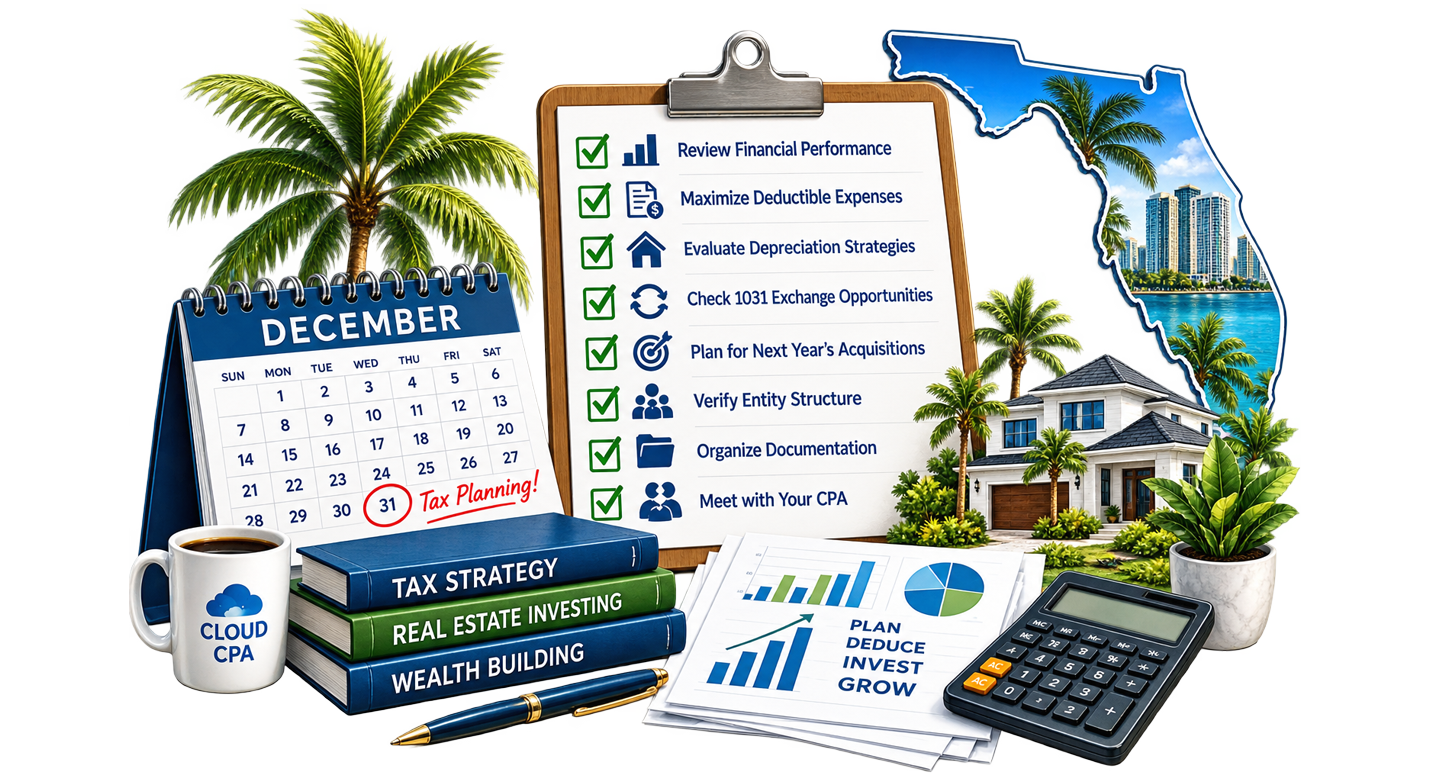
What Should Florida Real Estate Investors Do Before December 31?
Use this condensed year-end checklist:
- Update your bookkeeping.
- Reconcile all rental bank and credit card accounts.
- Record expenses paid personally.
- Review potential rental property deductions.
- Separate repairs from capital improvements.
- Review depreciation schedules.
- Identify assets placed in service during the year.
- Evaluate potential cost segregation opportunities.
- Review passive activity losses and carryforwards.
- Verify Real Estate Professional Status and material participation documentation when applicable.
- Review short-term rental activity separately.
- Analyze the tax consequences of planned property sales.
- Consider 1031 exchange planning before a qualifying sale.
- Review entity structures as the portfolio grows.
- Estimate your full-year tax liability.
- Review estimated tax payments.
- Organize records for your CPA.
- Schedule a proactive tax planning meeting.
Not every item requires action before December 31, and different rules have different deadlines. The purpose of the checklist is to identify issues early enough to determine what needs to happen now and what should be planned for the following year.
What Should You Include in Next Year’s Real Estate Tax Strategy?
The best year-end tax plan should produce a roadmap for the following year.
Before leaving your planning meeting, identify expected:
- Property acquisitions
- Property sales
- Renovations
- Financing or refinancing
- Short-term rental activity
- Changes in ownership
- New entities
- Cost segregation studies
- Bookkeeping improvements
- Estimated tax obligations
Tax planning becomes significantly more effective when your CPA knows about a transaction before it happens.
If you expect to purchase another rental property, for example, there may be decisions involving ownership, financing, depreciation, cost segregation, and bookkeeping that are easier to address before closing than afterward.
That is the central principle behind The Ultimate Florida Real Estate Investor Tax Planning Guide: tax planning should follow the investor throughout the year rather than begin when the return is due.
Frequently Asked Questions About Year-End Tax Planning for Florida Real Estate Investors
When should Florida real estate investors start year-end tax planning?
Florida real estate investors should ideally begin year-end tax planning well before December 31. Starting early gives you and your tax professional time to review income, expenses, depreciation, property transactions, estimated taxes, and potential planning opportunities while there may still be time to take action before the tax year closes.
What should a rental property investor review before December 31?
Rental property investors should review their year-to-date income and expenses, bookkeeping, depreciation schedules, passive losses, estimated tax payments, property purchases and sales, repairs and improvements, and documentation. Investors should also discuss any upcoming acquisitions or dispositions with their tax professional because transaction timing can affect the available tax-planning options.
What documents should I give my CPA for my rental properties?
Provide your CPA with accurate bookkeeping reports, bank and loan statements, closing documents, property tax records, insurance statements, receipts for repairs and improvements, mileage and travel records, depreciation schedules, and documents related to property purchases or sales. Your CPA may request additional records depending on your properties, entities, and tax situation.
Should I do a cost segregation study before year-end?
Possibly. A cost segregation study may accelerate depreciation by identifying qualifying components of a property that can be depreciated over shorter recovery periods. Whether it makes sense depends on factors such as the property, purchase price, placed-in-service date, expected holding period, tax situation, and current depreciation rules. A tax professional should evaluate the potential benefit.
Can I deduct rental property improvements at year-end?
Not necessarily. Many improvements must be capitalized and depreciated rather than deducted entirely in the year you pay for them. Repairs and certain qualifying expenditures may receive different treatment. Because classification can significantly affect your deduction, investors should review substantial renovations, replacements, and improvements with their tax professional before filing their return.
What happens to unused passive rental losses?
Passive rental losses that cannot currently be deducted are generally carried forward to future tax years rather than disappearing. They may become deductible when you have sufficient passive income or when certain other requirements are satisfied, including rules that can apply when you dispose of your entire interest in a passive activity.
Should I consider a 1031 exchange before selling a rental property?
If you are considering selling qualifying investment or business real estate and purchasing replacement real estate, discuss a potential 1031 exchange before the sale closes. A properly structured exchange has strict requirements and deadlines, and investors generally cannot simply decide after receiving the sale proceeds that they want to convert the transaction into a 1031 exchange.
How often should real estate investors meet with their CPA?
There is no single schedule appropriate for every investor, but tax planning should generally occur throughout the year rather than only when the tax return is due. Investors with acquisitions, sales, multiple properties, significant renovations, changing income, or complex entities may benefit from additional planning meetings before major financial decisions and again before year-end.